Why Were Mediterranean Villages Built on Hills?
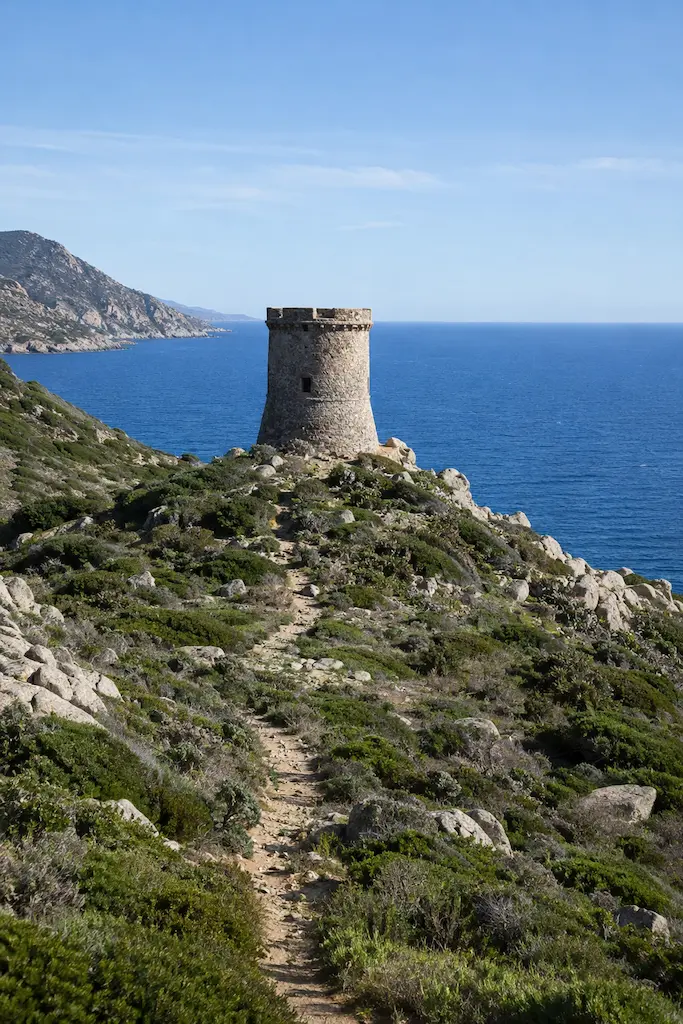
Along much of the Mediterranean coast, building high answered practical questions: how to defend a settlement, spot approaching ships, catch cooling breezes, and find space where steep hills left little flat ground beside the sea. Hilltop positions made settlements harder to attack, while coastal watchtowers gave lookouts time to identify danger and raise the alarm. In Corsica, Genoese towers watched for pirate raids. A sail on the horizon once required a rather different response from ordering another glass of wine.
Geography supplied both the opportunity and the inconvenience. Rocky spurs offered commanding positions; slopes required steps, winding lanes, and buildings fitted to uneven ground. Exposure could help a terrace catch the breeze, although elevation alone was no guarantee of summer comfort: shade and orientation mattered too. Sea breezes develop as land warms faster than the water, drawing cooler air inland. That makes access to moving air useful, without making it the explanation for every house on a hill.
These practical reasons did not produce one uniform Mediterranean way of building. A fortified village, a lighthouse, and a rooftop restaurant have different purposes and histories. Yet they share an advantage that is easy to appreciate from a chair: height opens up the coastline. Along the French Riviera, that advantage takes several forms, from the medieval position of Èze to the thoroughly theatrical pleasures of lunch above the waves.
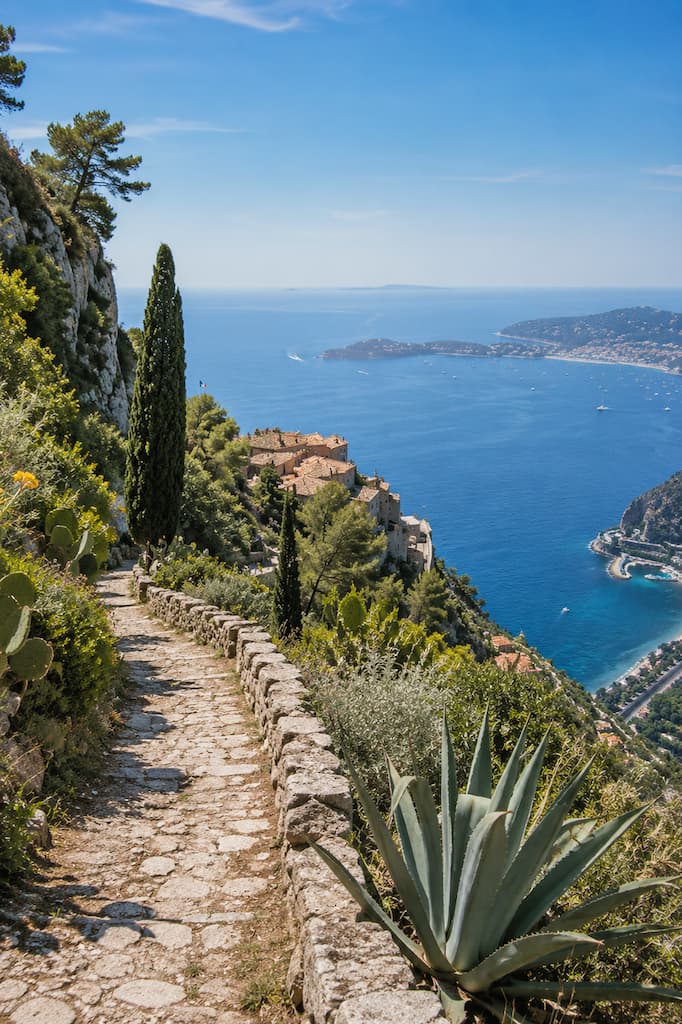
Èze makes the defensive logic particularly legible. The village clusters on a rocky outcrop, with narrow streets climbing toward the remains of its castle. At the summit, the Exotic Garden occupies the former fortress site, 429 metres above the sea. The setting now draws visitors for succulents and coastal panoramas, but the old relationship between height, visibility, and protection is still there in the terrain. Your legs will confirm the steepness long before you reach the garden.
The pleasure of the climb comes partly from how little the village reveals at once. Enclosed lanes give way to openings between buildings; close views of stone suddenly yield to a much larger landscape. The architecture controls the encounter. By the time the sea spreads out below, the view feels discovered rather than simply presented.
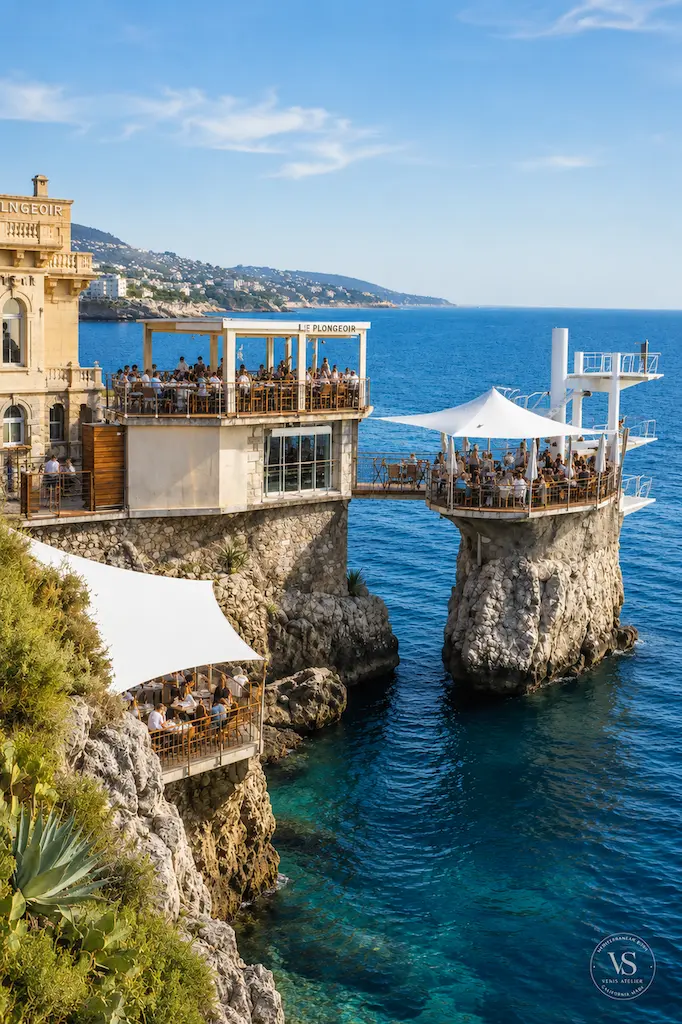
Nice offers a less defensive explanation for leaving the shoreline. At Le Plongeoir, the extraordinary setting was part of the attraction well before anyone had a phone to photograph it. In the late nineteenth century, a fishing boat was secured on the rock, allowing Belle Époque guests to eat and drink tea roughly six metres above the water. A walkway connected it to a gazebo. Apparently, taking a boat out to sea was only one possible use for it.
After the vessel was damaged, architect René Livieri was commissioned in 1941 to rework the site, introducing diving boards on the seaward side and a beach restaurant in place of the gazebo. The restaurant’s history complicates the neat idea that every elevated pleasure began as a necessity. Here, the spectacle was deliberate. The rock offered an opportunity to turn an ordinary meal into an occasion, and successive versions of the site kept finding ways to use it.
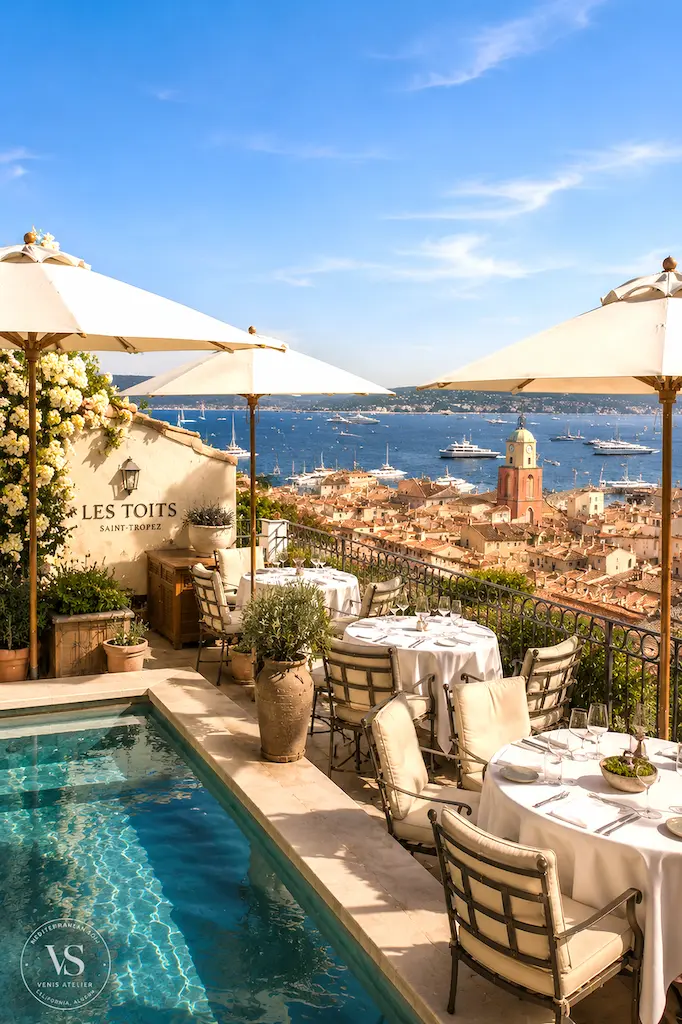
In Saint-Tropez, a rooftop achieves something quieter. Les Toits, at the Hôtel de Paris Saint-Tropez, places diners above the town with views across its roofs and the gulf. The appeal lies in that combination: the sea remains connected to the buildings and activity around it. From street level, the town arrives in fragments. From a terrace, roofs, shoreline, and boats become easier to read together. Lunch gives you time to notice the relationships.
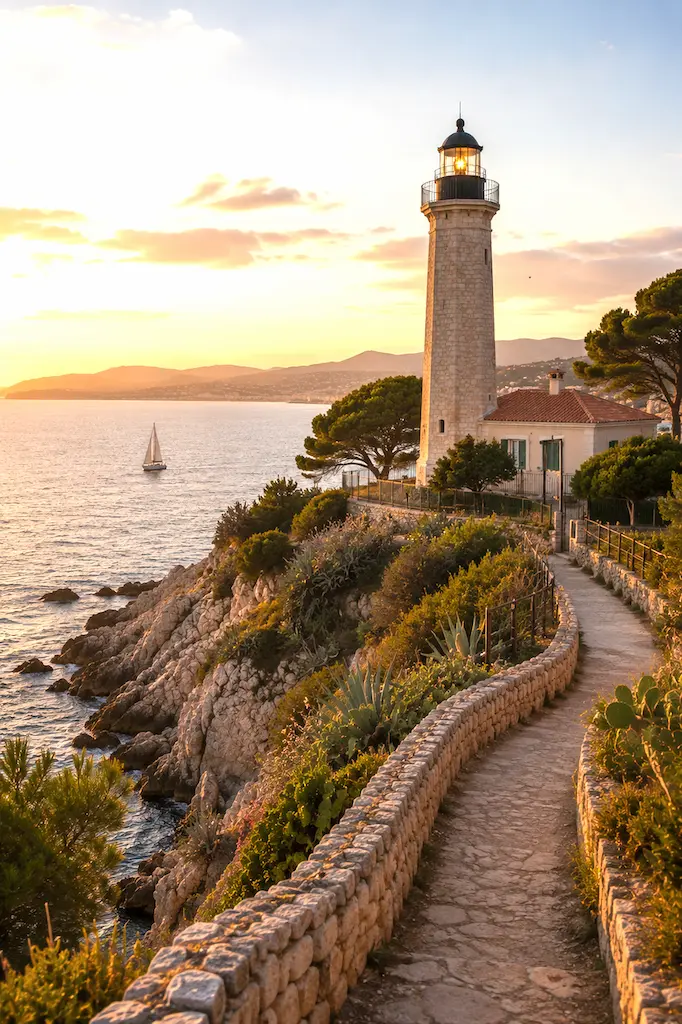
Above Cap d’Antibes, La Garoupe adds another distinction: a view can still be doing a job. The lighthouse remains active under the state’s Phares et Balises service, with a light reaching approximately 60 kilometres out to sea. Visitors may come for the panorama, but its navigational purpose continues. For someone looking outward from land, the horizon is scenery; for someone approaching by boat, the light helps establish where they are. The same elevated position serves both experiences.
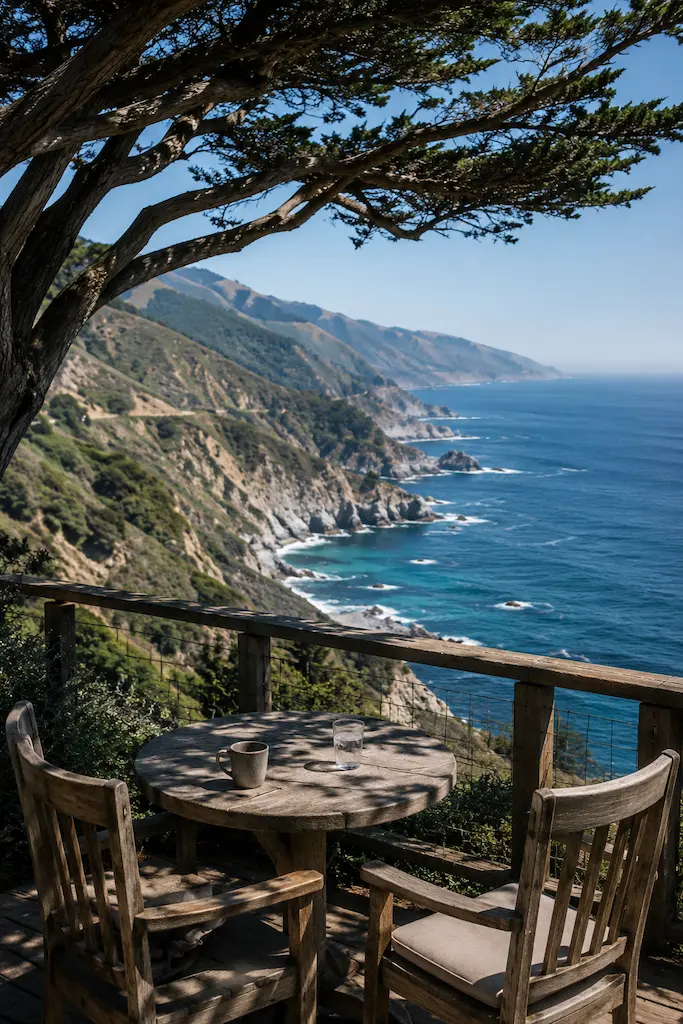
California has its own long relationship with the table above the water. At Nepenthe in Big Sur, which opened in 1949, a terrace high above the Pacific makes the coastline part of the gathering. It is a useful connection between the two shores: steep coastal geography creates the outlook, and a place to sit turns looking into time spent together. Neither coast needs lessons from the other in how to prolong lunch.
What makes these places interesting is the range of intentions behind them. Èze offers the terrain of a fortified settlement; Le Plongeoir turns a rock into a dining stage; Saint-Tropez brings the town into the view; La Garoupe continues to guide people across the water. Their histories give substance to what might otherwise become a collection of attractive horizons.
A table overlooking the Mediterranean can seem like the most effortless arrangement in the world. Behind it may lie difficult terrain, defensive planning, navigational engineering, or considerable determination to serve lunch somewhere improbable. That is worth remembering as you settle into your chair. Much of the work has already been done; the privilege is being able to look out to sea without having to keep watch.
Places to Explore
Les Toits, Saint-Tropez — Rooftop dining overlooking the harbor and terracotta rooftops.
Chemin de Nietzsche, Èze — A spectacular cliffside walk with sweeping Mediterranean views.
Le Plongeoir, Nice — An iconic restaurant suspended above the sea.
La Garoupe Lighthouse, Antibes — A rewarding climb to one of the French Riviera’s classic viewpoints.
CONTINUE EXPLORING
Inspired by this story? Continue your journey with ITALY | Puglia and the Art of Living Simply→