How the Same Two Colors Learned Two Different Ways to Dress
The Purity of White, the Intensity of Blue
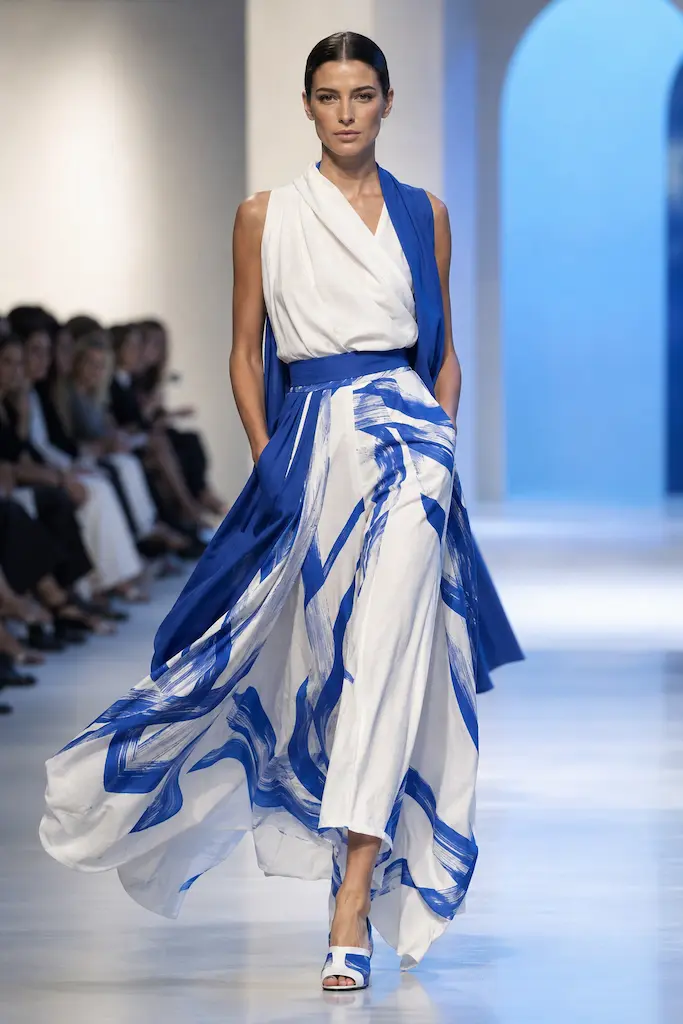
Dolce & Gabbana describes its Blu Mediterraneo palette through two qualities: “the purity of white” and “the intensity of blue.” It is a perfect explanation of why these colors have become fashion’s most enduring coastal pair. Inspired by Sicily’s hand-painted majolica ceramics, the house covers white dresses, caftans, shirts and skirts with elaborate cobalt flowers, leaves and ornamental scrolls. The patterns may be exuberant, but the clothes never feel visually heavy because white creates space around every flourish while blue supplies the depth and drama. Dolce & Gabbana does not simply use colors associated with the Mediterranean; it transforms the ceramics, whitewashed architecture and saturated sea of southern Italy into clothing. The house’s Blu Majolica print shows how two colors can carry an entire landscape and cultural tradition.
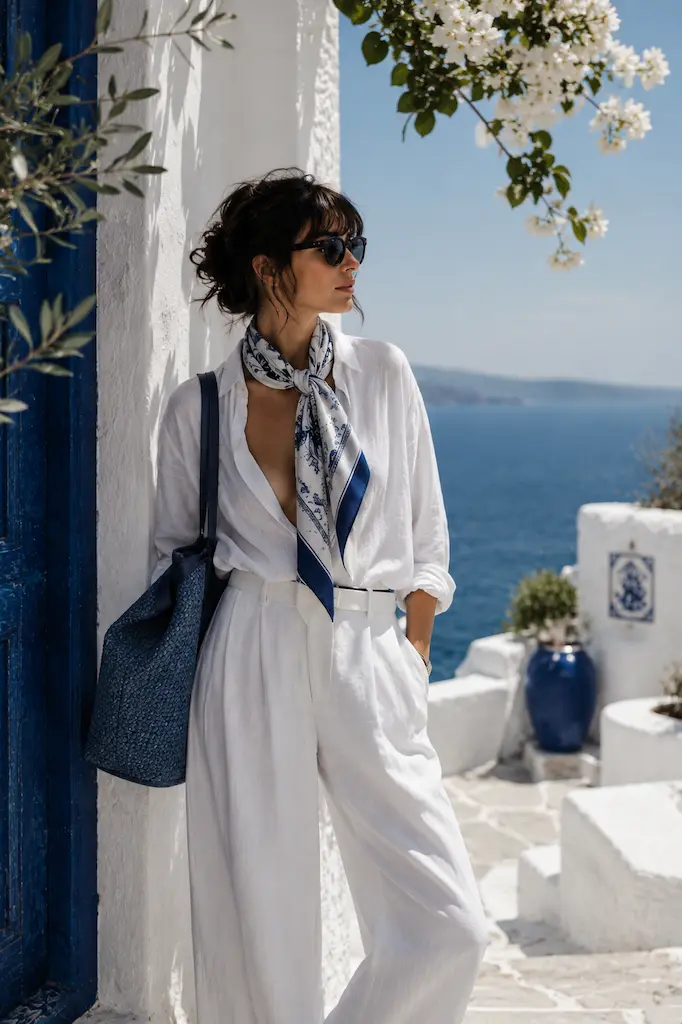
Blue and white are not technically complementary colors on the color wheel, but in clothing they complement each other unusually well. White is not a competing hue, so it allows every version of blue to become more distinct. Navy appears deeper beside white, cobalt becomes more brilliant, pale blue looks fresher and washed indigo reveals every variation created by wear. Blue returns the favor by giving white definition. An entirely white outfit can sometimes appear pristine, ceremonial or unfinished, but a navy knit, blue stripe or faded denim piece grounds it immediately. White brings light to blue, while blue prevents white from disappearing into the brightness of the coast.
The pairing also works across almost every degree of decoration. It can support the complexity of a Dolce & Gabbana majolica print or the simplicity of a white shirt worn with blue trousers. White space keeps intricate patterns controlled, while strong contrast gives plain garments structure without requiring additional colors. Texture becomes more visible within the restricted palette: natural creases catch the light on white linen, washed denim reveals softened threads, and woven cotton gains dimension where blue and white meet. These colors can be ornate or minimal, formal or relaxed, yet they almost always retain the clarity that makes them feel right beside the sea.
How Designers Taught the Colors to Dress
Dolce & Gabbana gives blue and white a decorative Sicilian identity, but other designers have used the same combination to express entirely different visions of coastal life. Jean Paul Gaultier repeatedly returned to the blue-and-white marinière until the sailor’s striped shirt became one of his signatures. Instead of ceramic scrolls, Gaultier used a simple horizontal line, but the same visual relationship remained: blue created rhythm and white prevented the repetition from becoming dense. The designer demonstrated how a practical naval garment could be reshaped, exaggerated and reinterpreted without losing the maritime history contained in its colors.
Gabrielle Chanel approached nautical clothing through freedom rather than decoration. During the early twentieth century, she adopted jersey, sailor-inspired knits, wide trousers and other elements associated with seaside life, offering women an alternative to highly constructed formal clothing. Blue and white helped make this new informality appear deliberate and elegant. The colors already belonged to sails, uniforms and coastal resorts, allowing relaxed garments to carry a familiar visual order. Chanel did not merely turn nautical clothing into fashion; she recognized that the coast offered women a more comfortable and modern way to dress.
Across the Atlantic, Ralph Lauren used blue and white to construct a polished American version of coastal style. Navy blazers, striped knits, crisp shirts and wide white trousers evoke sailing clubs, beach houses and summers in the Hamptons. His Spring 2025 presentation returned prominently to a seaside palette of blue and white, proving how easily navy can replace black when clothing moves into the sun. Dolce & Gabbana makes the combination exuberant, Gaultier makes it graphic, Chanel makes it liberating and Ralph Lauren makes it classically American. The colors remain recognizable through every interpretation because they are stronger than any single motif or fashion era.
There is also an emotional reason designers continue to use blue. Color psychology is more contextual than claims such as “blue makes everyone calm” suggest, but blue is consistently associated with ideas of openness, trust, distance and tranquility. Research into visits to natural blue spaces has found associations with positive well-being, although those benefits arise from the complete experience of being near water rather than from the color alone. White contributes cultural associations with freshness, simplicity and cleanliness. In fashion, these associations become especially persuasive during summer: blue suggests the open horizon, while white captures the brightness of sunlight reflecting across water.
Mediterranean Intensity Meets California Ease
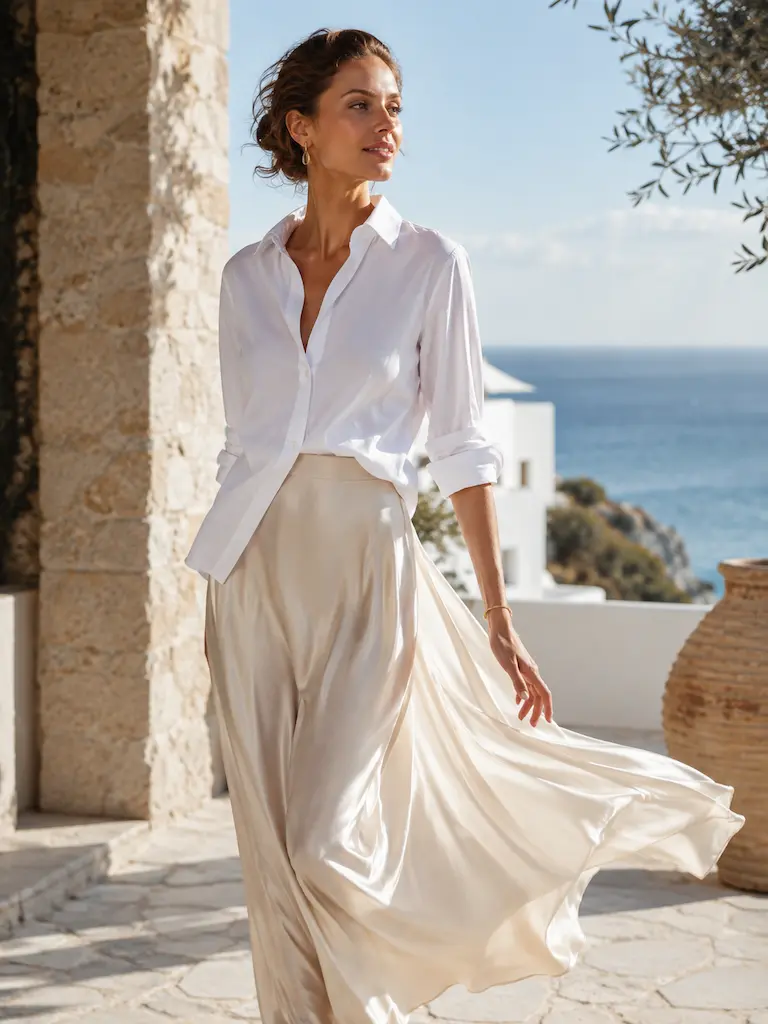
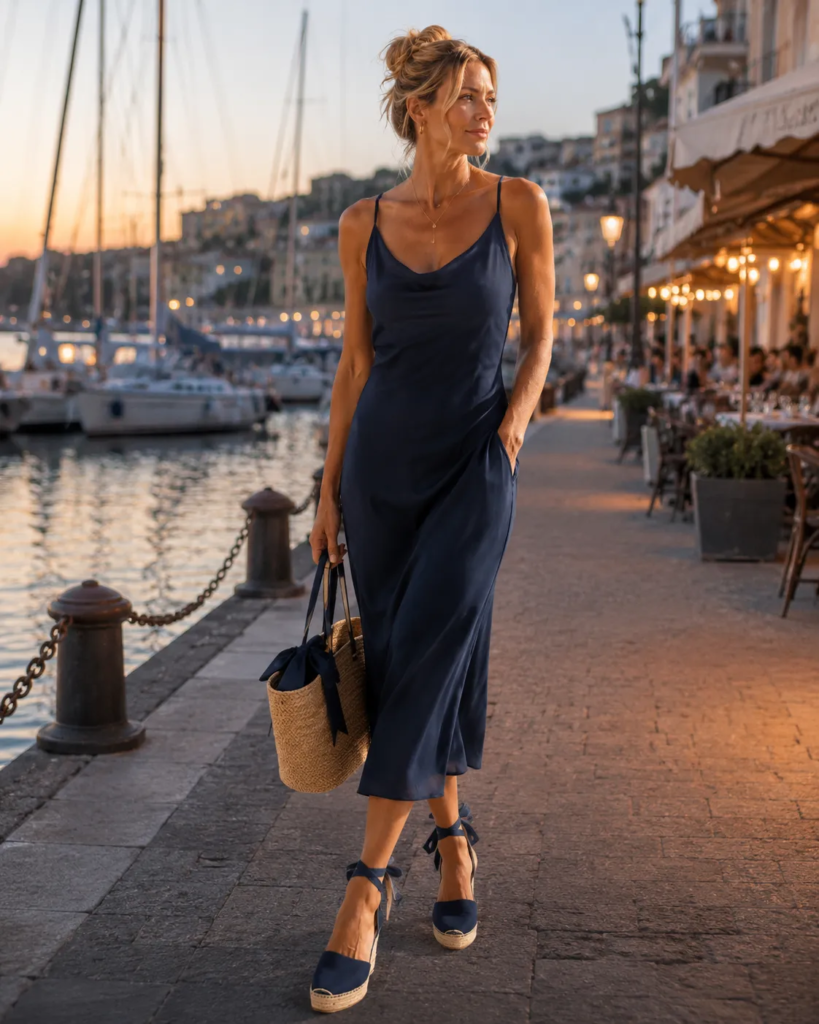
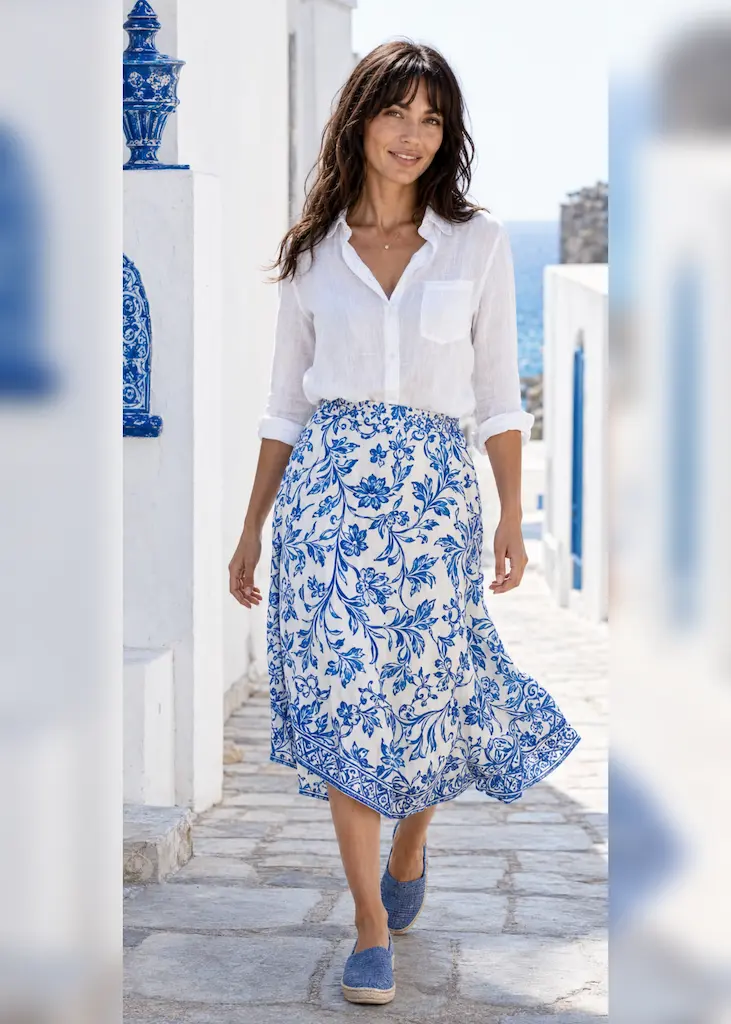
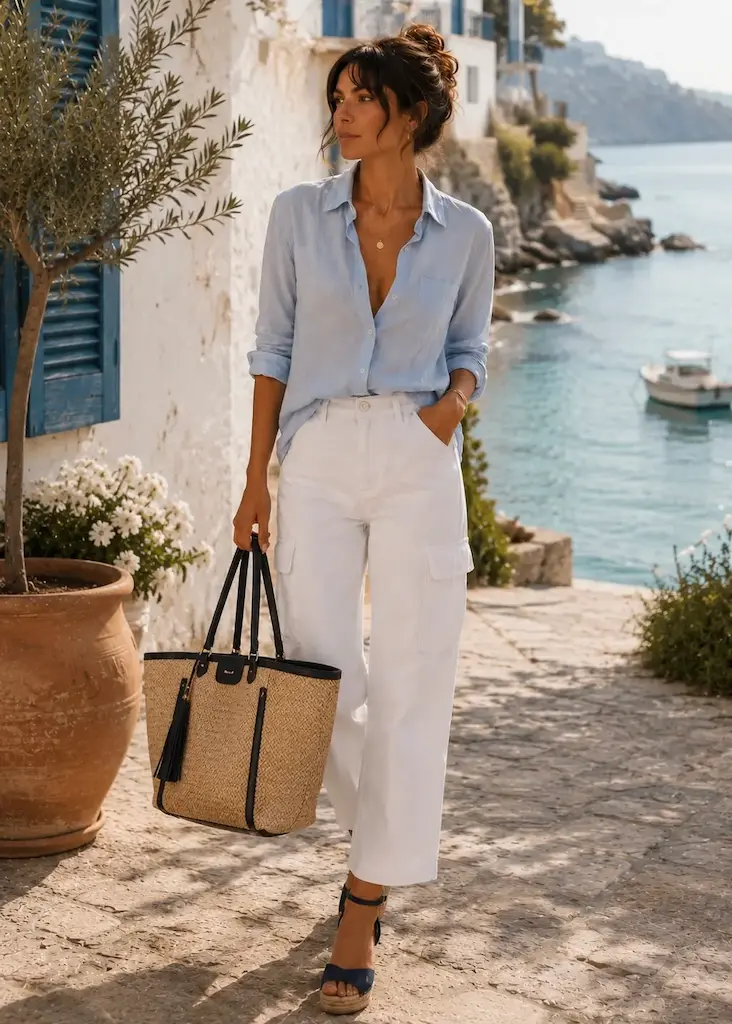
The Mediterranean tends to wear blue and white with greater definition. White linen is bright against deeply saturated blue, patterns recall ceramics and woven textiles, and silhouettes appear relaxed but intentionally composed. A cobalt-print skirt might be paired with a plain white shirt; loose navy trousers may sit beneath a beautifully cut linen blouse; a blue dress may be finished with white espadrilles and a natural-fiber basket. Even when the clothing is informal, the colors are kept clear and the proportions considered. The Mediterranean version reflects a culture in which clothing, architecture, ceramics and the landscape often share the same visual language.
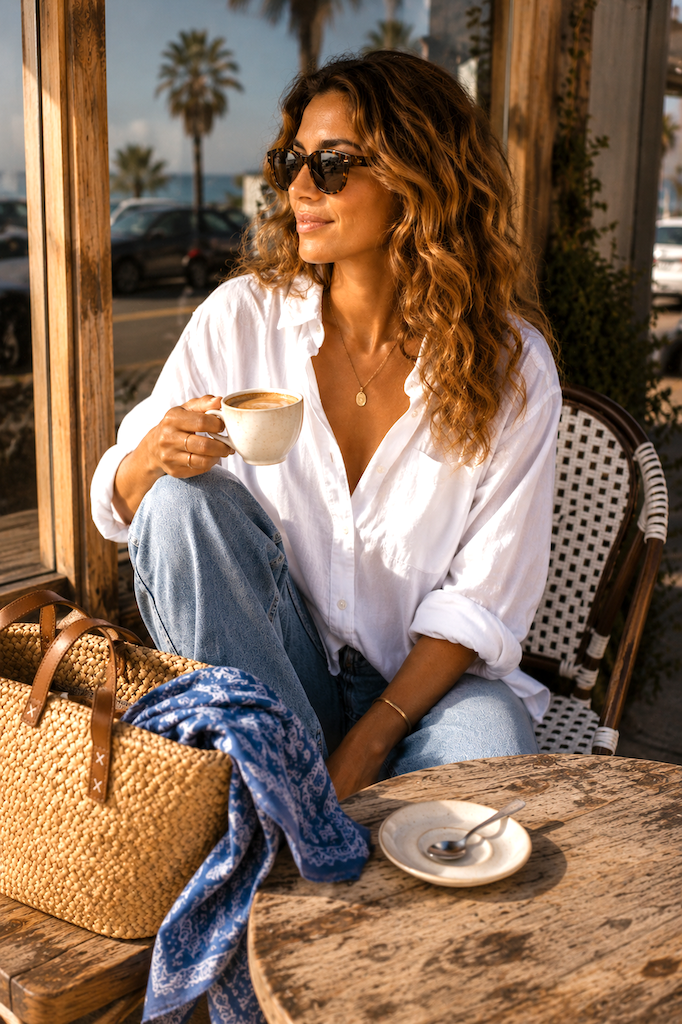
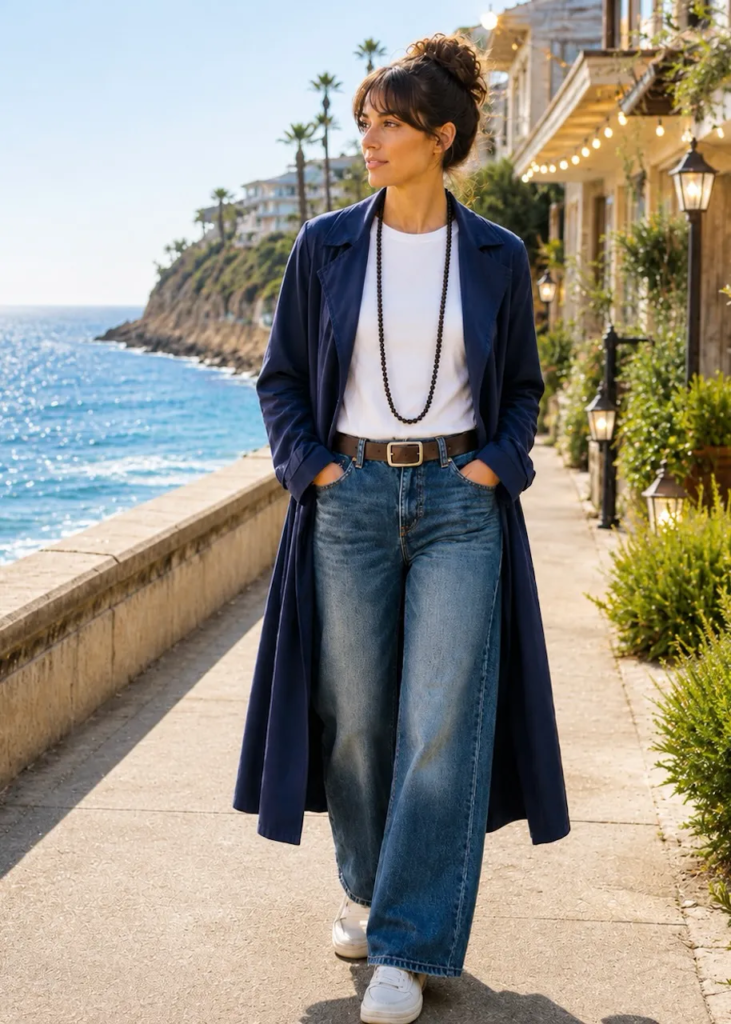
California takes the same palette and allows it to fade. Blue becomes washed denim, softened chambray or sun-worn cotton, while white appears in oversized shirts, easy dresses and simple tops that improve with repeated wear. The contrast is gentler and the styling less composed: a white shirt is half-tucked into faded jeans, a pale-blue button-down is worn open over a white swimsuit, or loose white trousers are combined with an indigo top and canvas sneakers. Where Mediterranean style preserves the intensity of cobalt against white, California lets blue soften toward the color of a hazy Pacific horizon.
This difference is what makes blue and white ideal for the Caliterranean wardrobe. Mediterranean clarity can be relaxed with California denim, while California basics can gain refinement through better linen, considered proportions and a single piece inspired by Mediterranean craft. A Breton stripe works on both shores because its history is specific but its visual language is universal. The objective is not to reproduce a designer collection or dress literally like a sailor; it is to understand why designers have returned to these colors for more than a century.
Blue and white endure because they contain everything a coastal outfit requires. Blue offers depth, character and emotional intensity; white introduces light, clarity and breathing room. In Sicily they can become an elaborate majolica dress, in France a striped sailor shirt, in the Hamptons a polished summer wardrobe and in California the simplest combination of white cotton and faded denim. The coast gave fashion the palette, but every shore taught it a different way to dress.
CONTINUE EXPLORING
Inspired by this story? Continue your journey with The Mediterranean Tradition of Knitted Style →