Why the Market Basket Still Works After Thousands of Years


Every generation seems convinced it has finally solved the shopping bag crisis. Paper replaced cloth. Plastic replaced paper. Then plastic became the villain and reusable bags arrived to rescue us from the reusable problem we had created in the first place. Nylon versions now fold into pouches the size of a fig. Canvas totes advertise museums, bookstores and opinions. Luxury houses have even managed to make grocery bags collectible, which is impressive considering their original purpose was carrying onions.
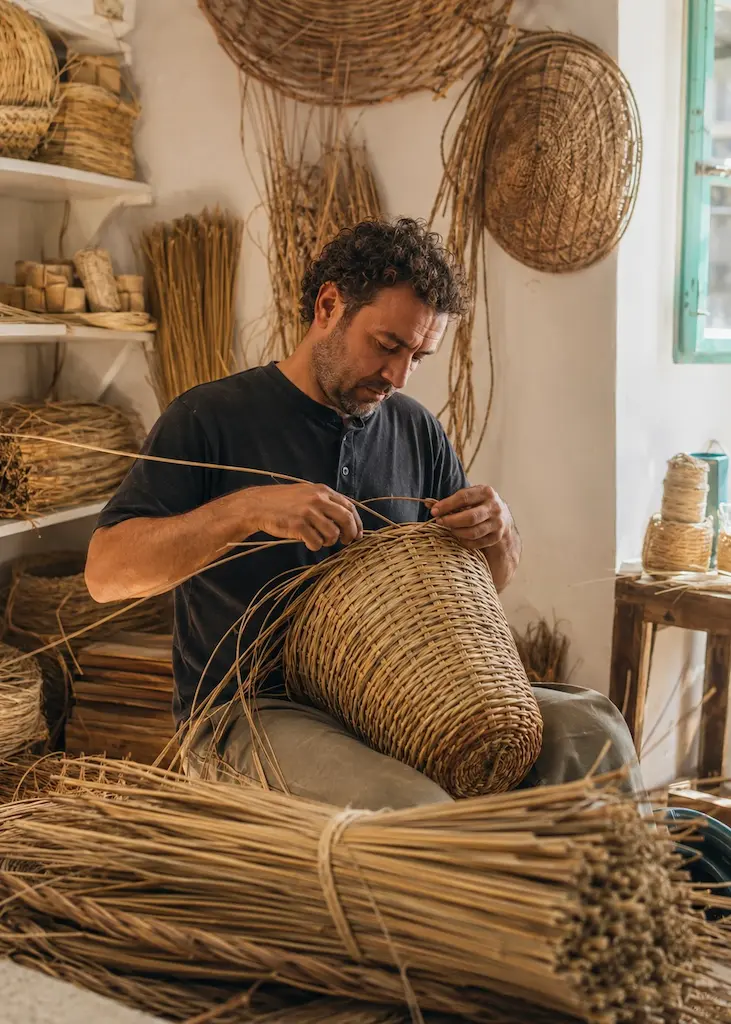
Meanwhile, the woven basket has spent several thousand years refusing to participate in the innovation cycle. That is the interesting part of its story. Basketry is among humanity’s oldest surviving crafts, although “surviving” is doing important work there. Plant fibers decay, so the archaeological record is far thinner than it is for stone or ceramics. Yet ancient basket remains show that people were already turning grasses, reeds and other flexible vegetation into useful containers thousands of years ago. Long before anyone invented packaging, humans had understood something beautifully basic: if you take material that grows around you and interlace it correctly, it becomes stronger than its individual parts.
The basket was essentially material intelligence with handles. And because the raw material changed from place to place, there was never one universal basket. Across Mediterranean regions, craftspeople worked with what the landscape provided: reeds, grasses, willow, palm and other pliable fibers. The resulting objects differed in shape, density and construction because their jobs differed too. Harvesting demanded one form. Carrying produce required another. Household storage, fishing, bread, grapes and market shopping each placed slightly different demands on the maker.
Good design, long before anybody called it design, was local. That makes the market basket especially interesting for us because it connects the Mediterranean and California without pretending the two coasts are identical. They are not. What they share is a useful set of conditions: strong sun, outdoor markets, agricultural regions, plants adapted to dry seasons and a culture in which objects frequently move between house, garden, street and shore.
A basket is very good at moving. It is light when empty. It has no rigid lid demanding that a tomato behave itself. Air can circulate through the weave. Oddly shaped objects can stick out of the top without causing an engineering crisis. Sand falls through it. A loaf of bread can exceed the official boundaries without anyone calling customer service.
Try asking most contemporary products to tolerate that level of improvisation. The basket’s other advantage is that use usually improves its appearance. Natural fibers soften. Pale surfaces deepen in tone. Handles become smoother where hands repeatedly grip them. Small irregularities make the object more individual rather than less desirable.
Industrial products often spend their lives trying to remain exactly as they looked the day they left the factory. A basket is allowed to admit that things happened to it. That may be one reason it became attractive beyond the field and market. Fashion has repeatedly adopted woven bags, particularly for summer, resort and coastal dressing. But fashion did not create their appeal. It borrowed an object whose proportions had already been worked out by necessity.
Contemporary designers are still proving the point. Loewe has made woven baskets a signature part of its summer collections, working with raffia, palm and other natural fibers while preserving the recognizable architecture of the original basket: an open body, woven structure and generous carrying space. Thousands of years of product development have apparently resulted in a rather unusual conclusion—the basic idea was already very good. The wide opening was not a styling decision. It made loading easier. The sturdy base was not an aesthetic gesture. Things needed to remain upright. The handles were not a charming heritage detail. Someone had to get the peaches home. Fashion occasionally encounters an object so well designed that the most sophisticated thing it can do is leave much of it alone.
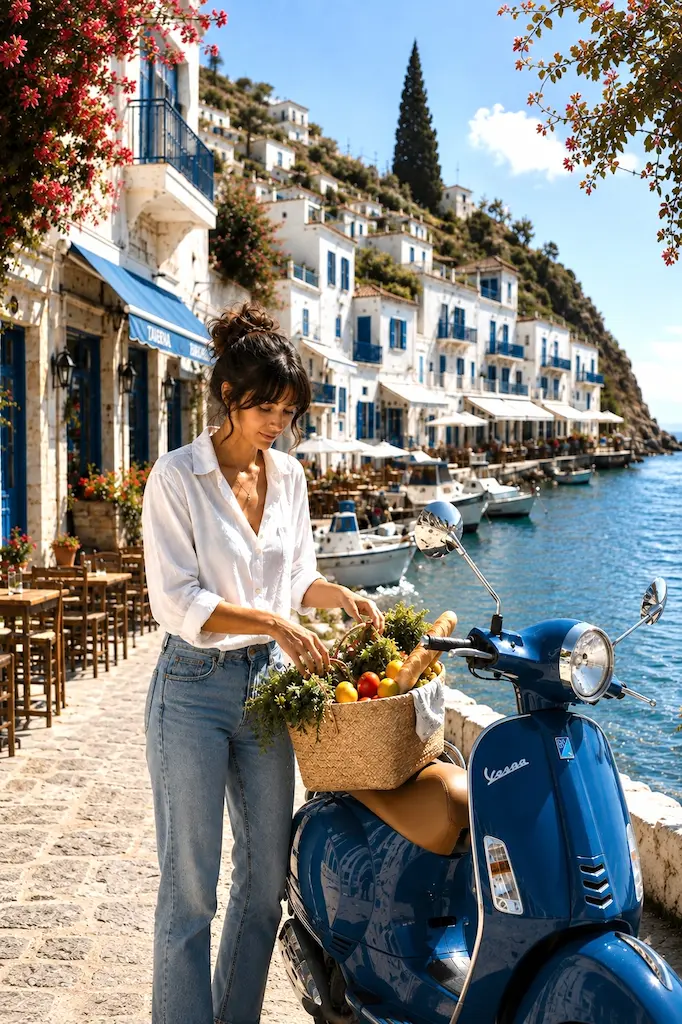
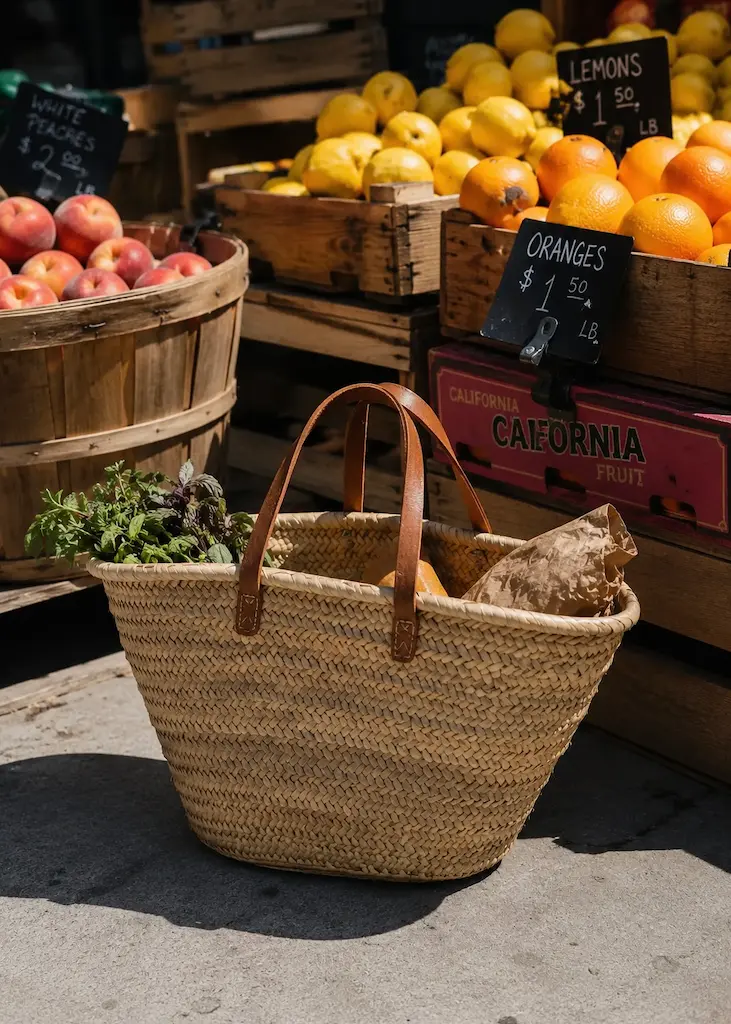
The basket is one of those objects. And this is where its continued presence in California becomes more interesting than a simple “Mediterranean style crossed the Atlantic” story. At farmers markets in Santa Barbara, Encinitas and other coastal towns, woven baskets now sit comfortably beside canvas totes, reusable bags and rolling carts. Their contents may include avocados, citrus, strawberries and California flowers rather than whatever was carried through a European village centuries ago, but the underlying problem has not changed. We still need to carry awkward things from one place to another.
Apparently civilization can become extremely advanced without improving on that requirement. The basket also imposes its own quiet design discipline. A shopping cart invites escalation. A basket eventually informs your arm that ambition has limits. There is something useful about an object that tells you when it is full.
Perhaps that explains why attempts to improve upon it so often become more complicated rather than more effective. Modern bags can be waterproof, collapsible, insulated, zipped, compartmentalized and printed with sustainability statements. All of those features can be useful. But each feature also solves a more specific problem. The basket succeeds because it remains unusually unspecific.
Fruit today. Towels tomorrow. Flowers, bread, newspapers, garden cuttings, children’s beach toys, a sweater when the evening cools down. Its usefulness comes partly from refusing to decide in advance what your life will require. That feels particularly appropriate to Caliterranean living, not because a woven basket is compulsory equipment for anyone living near the sea, but because it represents something both coasts understand when they are at their best: design can come from climate, material and use rather than decoration.
The best objects do not always announce where they belong. Sometimes they simply keep working until a place adopts them. The market basket has survived changing economies, new materials, supermarkets, plastic bags, designer totes and more trend cycles than anyone could reasonably count. It has been agricultural equipment, household tool, market companion and fashion accessory, often without changing very much at all. That is not a failure to evolve. It may be evidence that the evolution happened unusually early.
Some things need constant innovation. A basket simply needed two handles.
CONTINUE EXPLORING
Inspired by this story? Continue your journey with Why Coastal Towns Never Stopped Wearing Breton Stripes →