California’s Ice-Cream Makers Take On Italy’s Gelato Masters
Italy arrives at this contest with several centuries of prestige, generations of gelatieri and the quiet confidence of a country that considers an evening cone a perfectly reasonable social engagement. California arrives wearing sunglasses, carrying locally grown strawberries and wondering whether coconut cream might improve everything. One side perfected a tradition; the other looked at the tradition and immediately began changing the recipe.
At first, the winner appears painfully obvious. Italy has Florence, the Renaissance, the passeggiata and enough pistachio gelato to make a person distrust every pale-green imitation encountered elsewhere. California has the pint, the sundae and a tendency to put an entire bakery inside one scoop. Yet somewhere between Santa Barbara’s old creameries and Los Angeles’s coconut-based creations, the American challenger became considerably more sophisticated.
The battle is not simply ice cream against gelato, because the two are close relatives rather than opposing species. Both begin with some arrangement of milk, cream, sugar and flavoring, although sorbetti and contemporary plant-based versions happily complicate that description. The real difference lies in how those ingredients are balanced, frozen, served and, perhaps most revealingly, imagined.
Round One: The Rules of Cold
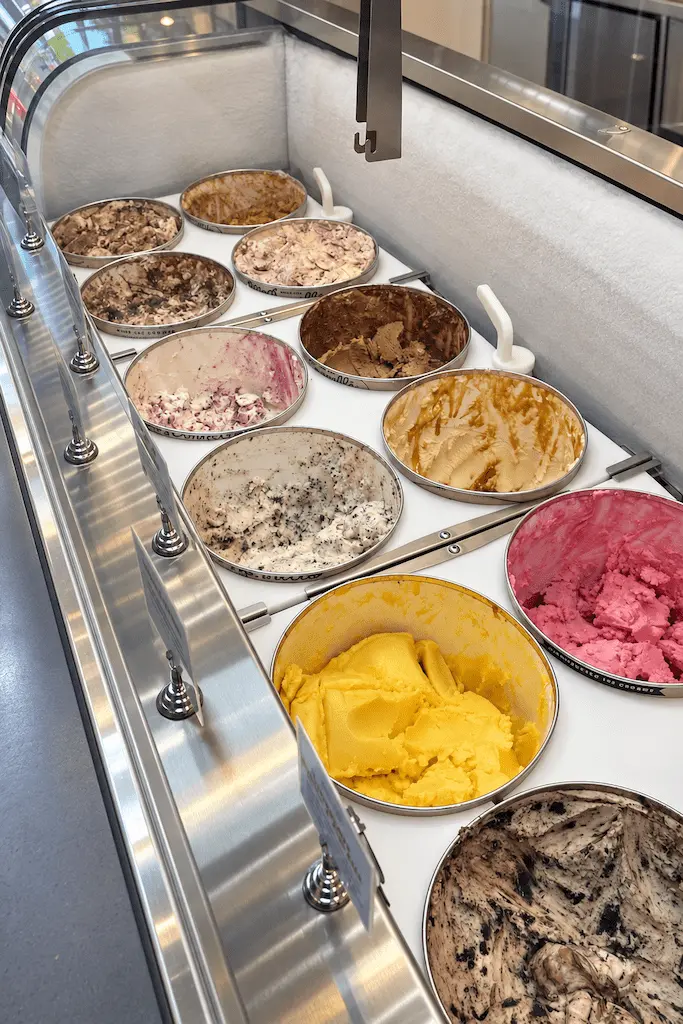
American ice cream sold under that name must contain at least 10 percent milk fat under federal standards. It is generally made with more cream than gelato, churned with more air and served at a colder temperature, producing a firmer, richer scoop. The cold allows it to survive grocery freezers, car journeys and the peculiar American custom of returning a half-eaten pint to the freezer as though such restraint will happen twice.
Italian gelato usually relies more heavily on milk, contains less fat and incorporates less air during churning. It is served warmer than conventional American ice cream, which gives it that soft, elastic texture and allows flavor to reach the palate before the cold numbs it. Gelato can therefore taste intensely creamy while containing less cream, one of those irritating Italian achievements that seems to defy both physics and fairness.
Less fat is not automatically more virtuous, and more cream is not evidence of moral decline. Fat contributes richness and carries flavor, but it can also soften the sharpness of fruit, nuts and chocolate. The gelatiere compensates with temperature and balance; the ice-cream maker answers with body, density and the unapologetic pleasure of cream.
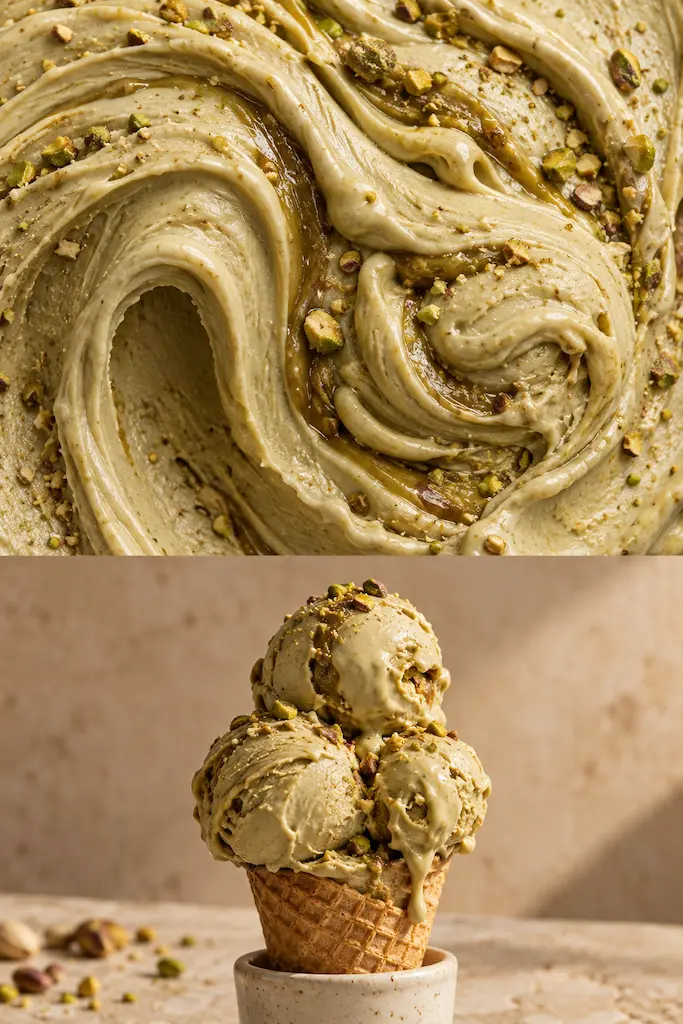
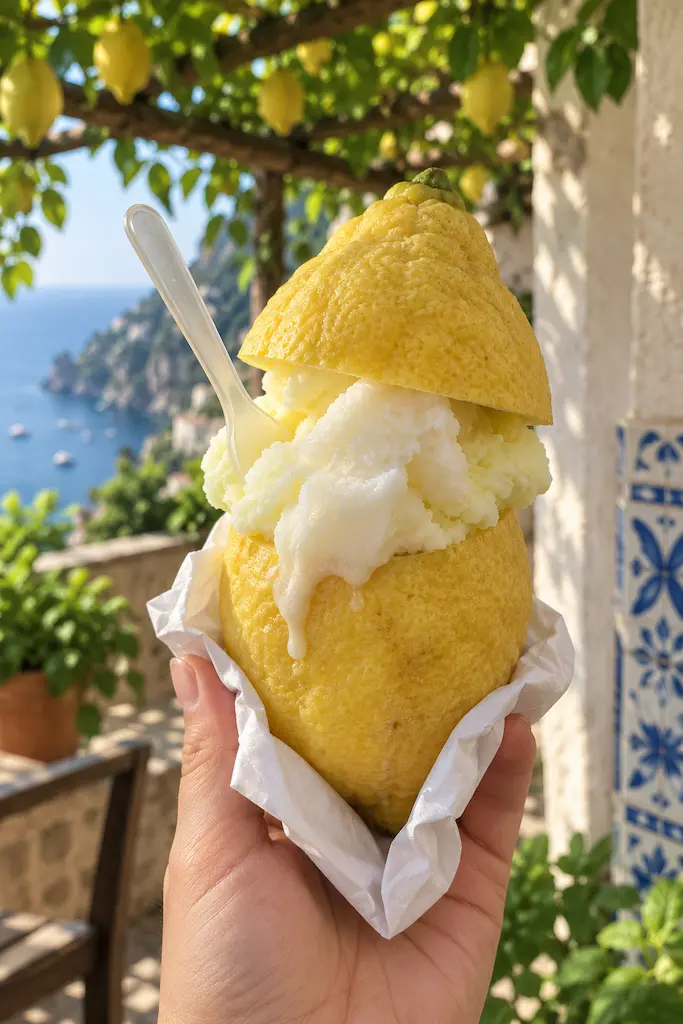
Italy’s classic strength is clarity. A great pistachio gelato does not taste vaguely nutty, conspicuously sweet or alarmingly fluorescent; it tastes unmistakably of pistachio. Hazelnut becomes more hazelnut-like, lemon seems newly introduced to itself, and a ripe peach is given the flattering opportunity to become colder without losing its identity.
California often takes the opposite approach. Its makers are inclined to begin with the peach, introduce it to buttermilk, add a ribbon of preserves and perhaps invite a crumble to stay. Italy asks how perfectly one ingredient can be expressed, while California asks how many interesting things can happen before the lid goes back on.
The First California Scoops
California’s ice-cream story began long before today’s experimental shops. Founded in Oakland in 1894, Fentons Creamery is generally regarded as the state’s oldest continuously operating creamery and ice-cream institution, although it began as a dairy business before ice-cream production became central to the family enterprise. Its towering sundaes, house-made sauces and Toasted Almond flavor belong to the American fountain tradition: generous, sociable and constitutionally opposed to understatement.
Fentons also stands near the center of California’s disputed Rocky Road story. The creamery credits its candy maker George Farren with blending a Rocky Road-style candy into ice cream, while Dreyer’s has its own version involving William Dreyer, marshmallows and his wife’s sewing scissors. The precise inventor remains contested, but the flavor itself revealed something enduring about California ice cream: one perfectly good ingredient was apparently considered lonely.
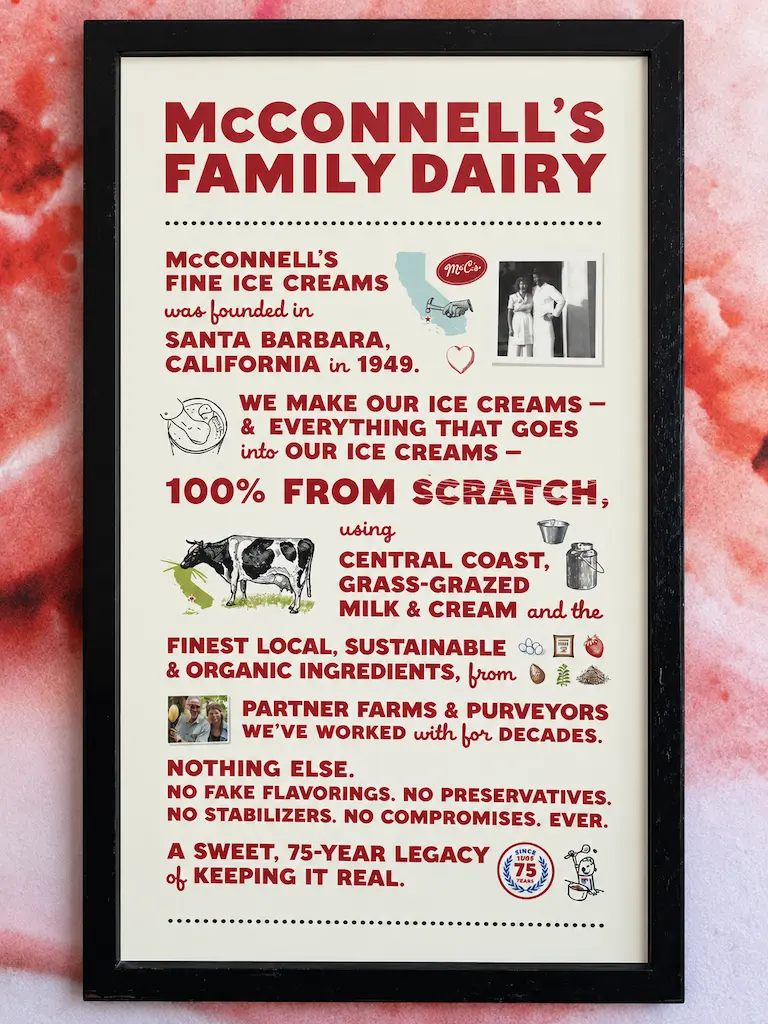
McConnell’s Fine Ice Creams, founded in Santa Barbara in 1949, brought a different kind of seriousness to the scoop. Gordon “Mac” and Ernesteen McConnell developed their recipes alongside a mechanized version of the European French-pot process, opening their first shop in 1950. They built their reputation on Central Coast dairy, dense texture and making components such as jams, caramels and baked additions rather than treating “made from scratch” as decorative language.
McConnell’s is not gelato, and its European process should not be mistaken for direct Italian descent. It represents something more distinctly Californian: Old World craft filtered through agricultural abundance and American appetite. Its flavors can contain espresso, berry preserves, streusel, chocolate, cookies and enough textural activity to qualify as a small construction project.
Round Two: The Ingredient or the Invention?
If Italy’s gelato culture were merely traditional, California could claim modernity without much effort. Unfortunately for that tidy argument, contemporary Italian gelatieri are inventive enough to make the word “traditional” feel suspiciously incomplete. They respect technique, but respect has never prevented an Italian from having a strong opinion about how something could be improved.
In Senigallia, master gelatiere Paolo Brunelli works at the intersection of gelato, pastry and chocolate. His celebrated Crema Brunelli sits comfortably beside experiments in texture, temperature and sweet-savory balance. Italy’s innovation often works this way: the foundations remain visible even while the room above them is being rearranged.
At Ciacco Lab, Stefano Guizzetti applies his food-science background to recipes built around precise texture, temperature and aromatic progression. Ciacco has produced unexpected creations including egg, butter and sage, while also developing water-based versions of flavors commonly associated with dairy. Italian restraint, it turns out, can include fried-egg gelato; restraint is evidently a flexible concept.
Rome’s Otaleg makes the rebellion even clearer. Marco Radicioni is admired for exceptionally concentrated fruit and nut flavors, but his savory experiments have included fennel marinated in white-wine vinegar and even panzanella—the Tuscan salad of bread, tomato and basil—transformed into gelato. California may be fearless, but Italy has apparently frozen lunch.
The difference is therefore not that Italy preserves while California invents. Italy usually innovates from inside the discipline of gelato, concentrating flavor and testing how far a familiar form can stretch without losing its identity. California is more willing to treat ice cream as an open platform into which another dessert, another culture or an entirely different milk can be invited.
California Removes the Borders
Los Angeles maker Wanderlust Creamery turns the display case into a map. Co-founder Adrienne Borlongan studied food science and has developed flavors inspired by culinary traditions around the world, including Ube Malted Crunch, Japanese Neapolitan, Australian Pavlova and Hanoi Egg Coffee. A commercial gelato machine helped start the business, but the resulting language could only have developed in California: technically informed, culturally restless and uninterested in remaining within one national tradition.
This global approach is not simply a parade of novelty ingredients. California’s population allows makers to draw on flavors connected to memory, migration and neighborhood life rather than an abstract idea of “fusion.” Filipino ube, Persian saffron, Mexican chamoy, Japanese matcha and Vietnamese coffee can share a city without being reduced to one generic international scoop.
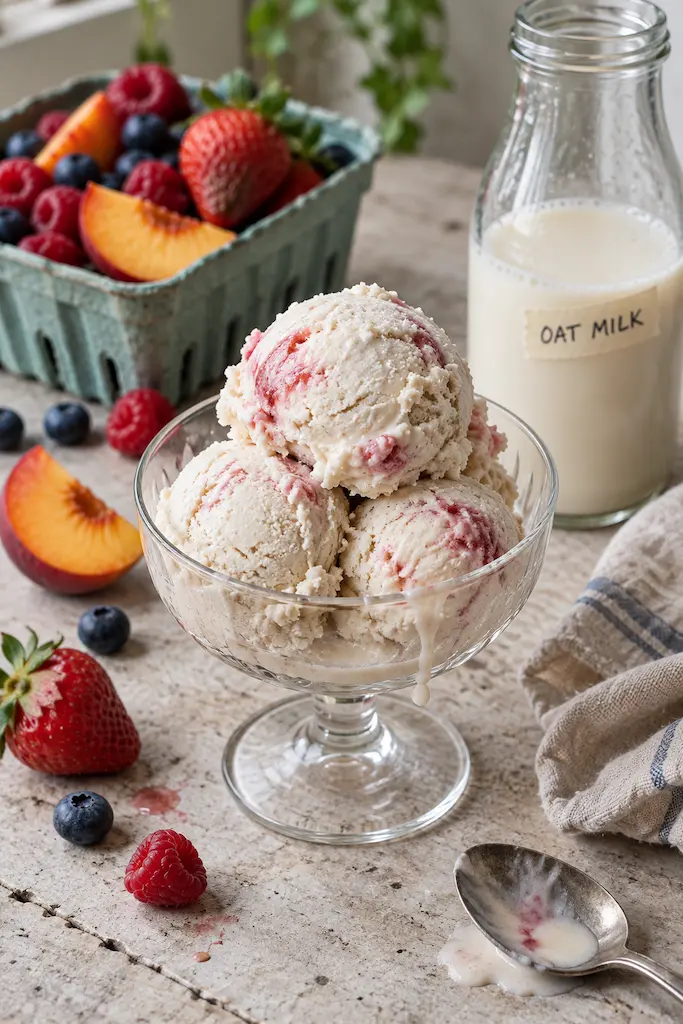
That freedom is also changing what ice cream needs to contain. At Los Angeles-based Awan, Indonesian coconut cream and coconut water replace dairy, while Balinese vanilla, palm sugar and flavors such as saffron, pistachio and Medjool date provide depth. The result is not presented as the dutiful vegan version standing sadly beside the real dessert; it is the dessert.
California did not invent dairy-free frozen sweets, of course. Italian fruit sorbetti have long achieved brilliance without milk, and experimental gelaterie such as Ciacco now make dairy-free pistachio, chocolate and coffee alongside fruit flavors. The distinction is that California increasingly treats plant-based formulation as a creative identity of its own, not merely an accommodation or a separate corner of the menu.
Round Three: The Ritual
A California scoop is frequently designed to travel. It leaves the shop in a pint, crosses a freeway, enters a domestic freezer and waits for a person who fully intends to eat only a reasonable amount. Its formulation must tolerate colder storage and repeated visits, giving American ice cream a life beyond the moment in which it is served.
Italian artisan gelato is more closely attached to immediacy. It is made to be eaten softer and warmer, often within steps of the gelateria, while walking through a piazza or joining the evening passeggiata. The cone is not stored for later because Italy has wisely declined to solve a problem nobody needed to create.
This may be Italy’s most difficult advantage to defeat. California can reproduce the density, import the machinery and source pistachios with impeccable credentials, but it cannot package the sound of an Italian street at ten in the evening. Gelato is not only a recipe there; it is a small public ritual in a culture that still allows pleasure to occupy time.
California offers a different ritual built around discovery. The pleasure lies in finding a new shop, deciphering an impossible flavor list and tasting something that may combine childhood nostalgia with ingredients from several continents. Italy offers recognition refined to perfection; California offers the possibility of being surprised.
And the Crown Goes To…
Italy wins the classical rounds. Its finest gelatieri understand how air, sugar, fat and temperature can be adjusted until an ingredient seems to speak more clearly than it does in nature. It also retains the greater ritual, because even exceptional ice cream eaten beside an open dishwasher struggles to compete with gelato during an evening walk through Rome.
California wins the reinvention round. Its makers have transformed the scoop into a composed dessert, a record of migration, a showcase for local agriculture and a serious laboratory for plant-based pleasure. They are not trying to make a better imitation of Italy; increasingly, they are making something Italy would not have thought to attempt—or might have considered impolite until recently.
The final result is an inconvenient tie, which is what happens when a competition is organized by people hoping to continue eating from both sides. Italy perfected gelato by learning what to leave out, while California reinvented ice cream by deciding what else could go in. One guards the purity of the ingredient, the other tests the limits of the scoop, and neither appears remotely willing to surrender the crown.
CONTINUE EXPLORING
Inspired by this story? The story continues. Here is your next read The California – Mediterranean Pantry →