Coastal Rail Journeys Through California and the Mediterranean
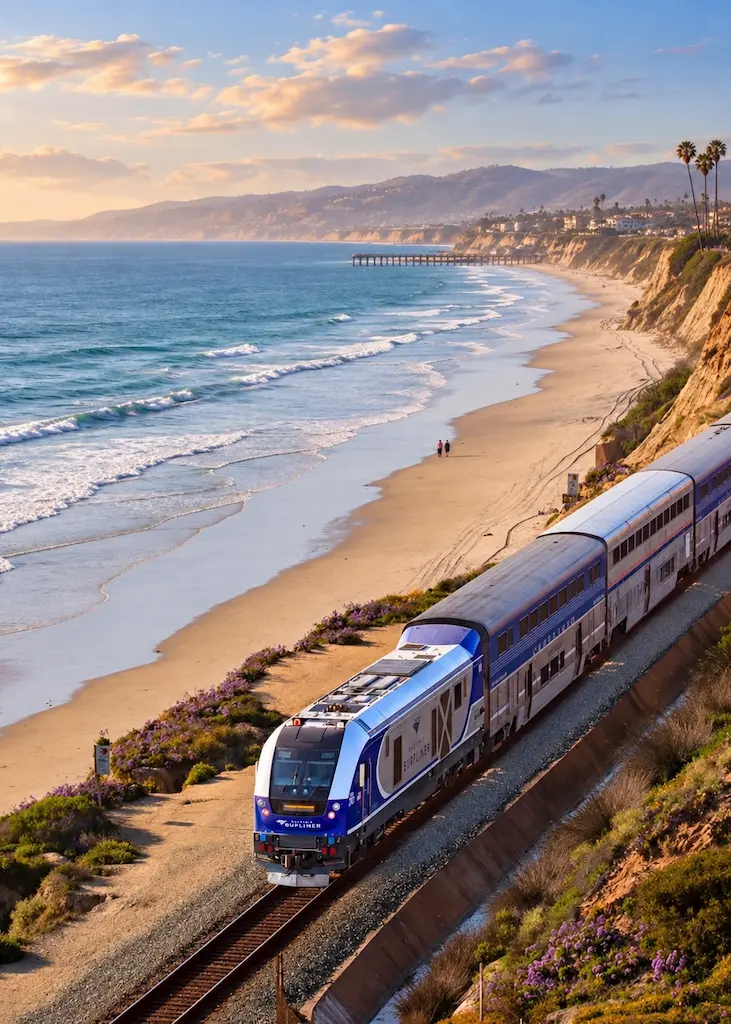
The best thing about a train window is that it refuses to be useful. It does not tell you where to turn, suggest a faster route or announce that parking at your destination is “busier than usual.” It simply frames the world and asks you to look.
For more than a century, the romance of railway travel has belonged to trains like the Orient Express: polished wood, sleeping compartments, white tablecloths and the wonderfully theatrical suggestion that getting somewhere should require dressing for dinner. But perhaps we have been looking for glamour in the wrong carriage. The modern coastal train is often perfectly ordinary—backpacks overhead, coffee in paper cups, someone conducting a telephone conversation apparently intended for the entire carriage—and then the train rounds a bend and the Pacific is outside your window.
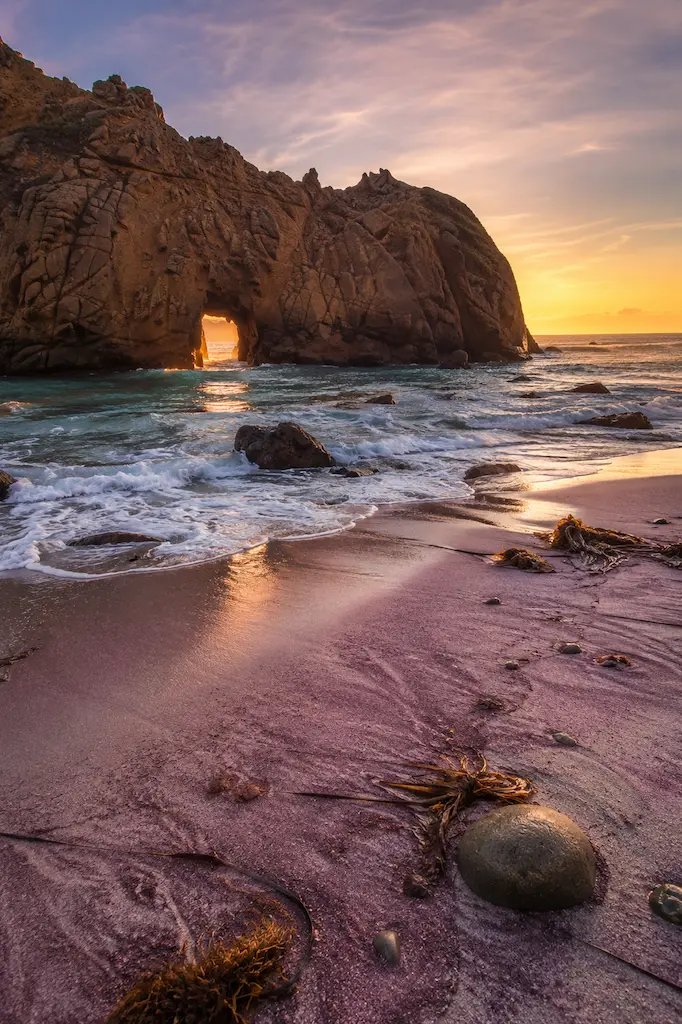
California’s Pacific Surfliner follows a 351-mile corridor through San Diego, Orange, Los Angeles, Ventura, Santa Barbara and San Luis Obispo counties. Between San Diego and San Clemente, the railway repeatedly approaches the ocean until, at times, it seems less like a train route than a slight administrative intrusion onto the beach. Sit on the west side and there are surfers waiting beyond the break, lifeguard towers in the morning haze and stretches of sand close enough to make you wonder whether shoes were really necessary.
Continue north and Los Angeles eventually loosens its grip. Beyond Ventura and Santa Barbara, the landscape becomes quieter: ochre hills, eucalyptus, pale grass and an increasingly exposed Pacific. The pleasure is partly that you cannot stop every time something beautiful appears; a lonely beach enters the window, becomes magnificent and disappears before you can turn it into content. You missed the photograph, but you actually saw it.
The Mediterranean by Regional Train
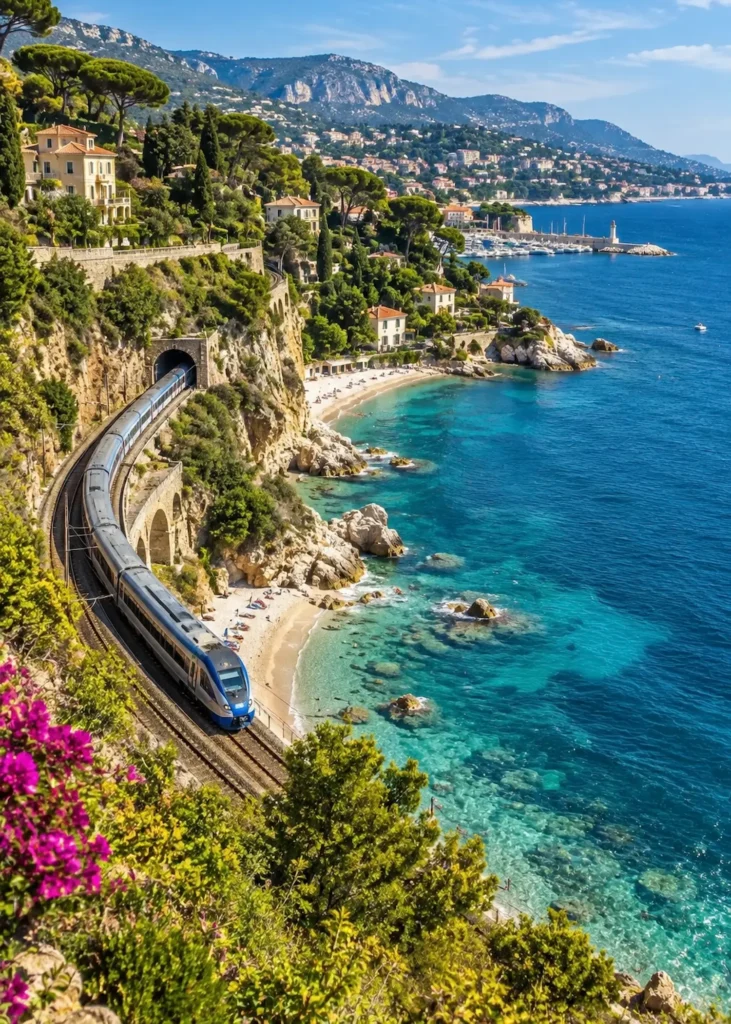
Across the Atlantic, the same idea becomes warmer, older and considerably better supplied with focaccia. From Marseille to Nice, regular trains travel through Toulon, Saint-Raphaël, Cannes and Antibes, turning one of Europe’s most famous coastlines into something surprisingly practical. The Mediterranean appears between towns and headlands, vanishes behind a tunnel and then returns in a flash of silver-blue, as though the railway were opening and closing curtains.
Begin with a navette from Marseille, the traditional boat-shaped biscuit scented with orange blossom, and suddenly even railway snacking has acquired local history. Farther east, Nice offers socca, pan bagnat and pissaladière, foods that seem specifically designed to prove that lunch does not improve merely because someone has arranged microgreens on it. Better still, leave the train at Antibes and walk toward the old town and harbour, where warm stone, shutters and salt air make the Riviera feel less like a brand and more like a place.
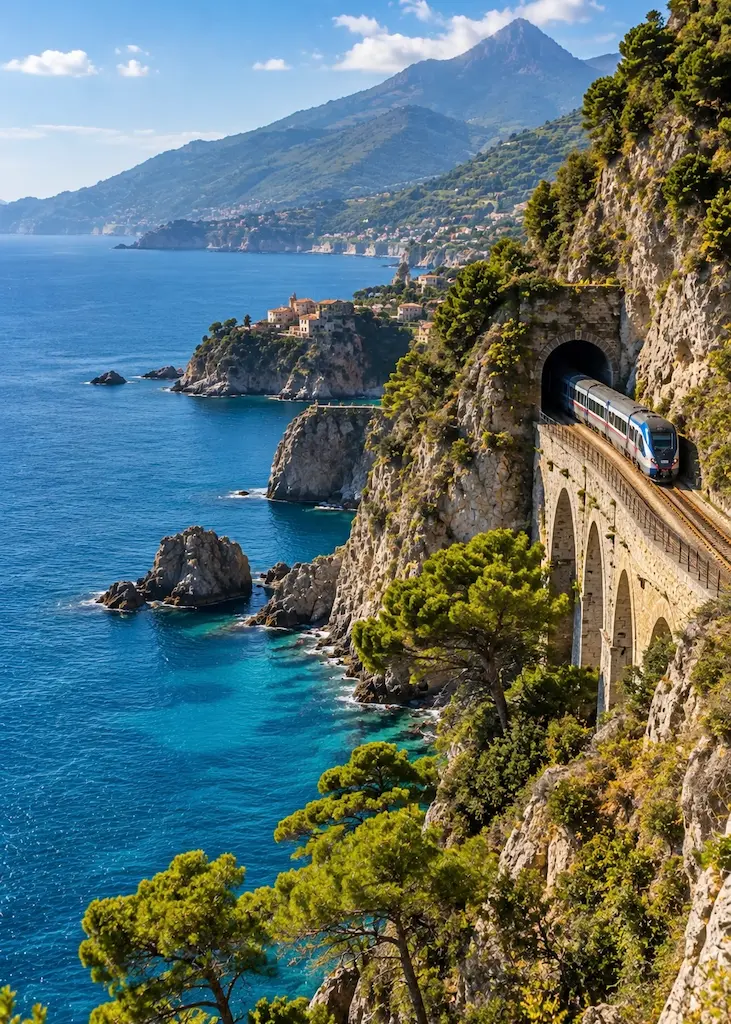
Then there is Liguria, where geography appears to have left very little room for transportation and the Italians built a railway anyway. From Genoa east toward Camogli, Sestri Levante and Levanto, the train slips repeatedly through mountains: tunnel, darkness, sea, pastel village, another tunnel, sea again. You begin waiting for each return of blue with the mild obsession of someone who knows exactly how the magic trick works and still wants to see it again.
Focaccia is the correct companion here, preferably warm and wrapped in paper. Continue toward the Cinque Terre if you must—they remain beautiful despite having been photographed from approximately every possible angle—but consider getting off earlier at Camogli or Sestri Levante. Sometimes the more memorable coastal town is the one you did not arrive already knowing how to photograph.
South Until the Land Runs Out
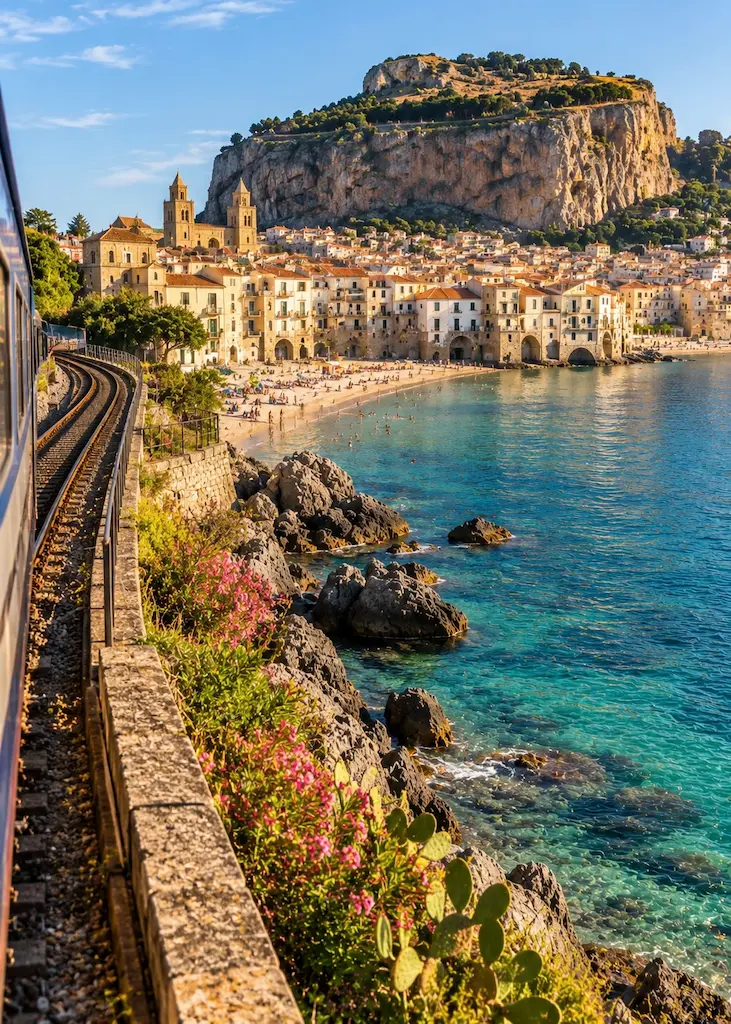
Sicily gives the railway a different rhythm. Leaving Palermo for Cefalù, the train begins among the ordinary edges of the city before the Tyrrhenian Sea starts appearing beside it, first in fragments and then in long sweeps of blue. Cefalù is an irresistible interruption: the great rock behind the town, honey-coloured streets below it, the Norman cathedral holding court in the square and the beach only minutes away.
Take an arancina for the journey, because Sicily has managed to turn the grammatical gender of fried rice into a regional dispute—and save room for granita with brioche. Then continue east toward Messina, where smaller stations, fishing towns and mountains slide between carriage and sea. Resist looking up every village as it passes; not knowing exactly where you are can still be one of travel’s pleasures.
For the longest version of this escape, return to mainland Italy and take the railway south from Naples through Salerno toward Maratea and Calabria. Here the country seems gradually to exhale: towns become smaller, mountains approach the Tyrrhenian and the light grows harder and clearer. Maratea offers cliffs and quiet; farther south lie the Calabrian coast, Tropea and eventually Reggio Calabria, where Sicily waits visibly across the Strait of Messina.
None of these trains requires a tuxedo, and nobody is likely to place a silver dome over your lunch. There will be luggage in inconvenient places, incomprehensible announcements and at least one passenger who regards headphones as an attack on personal freedom. Yet this may be the more interesting luxury: not being responsible for the road, not searching for parking, not trying to conquer the coastline at all.
A train allows the coast to come to us. The Pacific fills the glass at San Clemente, the Mediterranean reappears after a Provençal tunnel, warm focaccia disappears somewhere beyond Genoa and evening settles over the Tyrrhenian outside Cefalù. Years later, the timetable will be forgotten, but perhaps not that peculiar sadness of watching a beautiful place disappear before you were ready—the small price of traveling beside the sea without ever pretending it belonged to you.
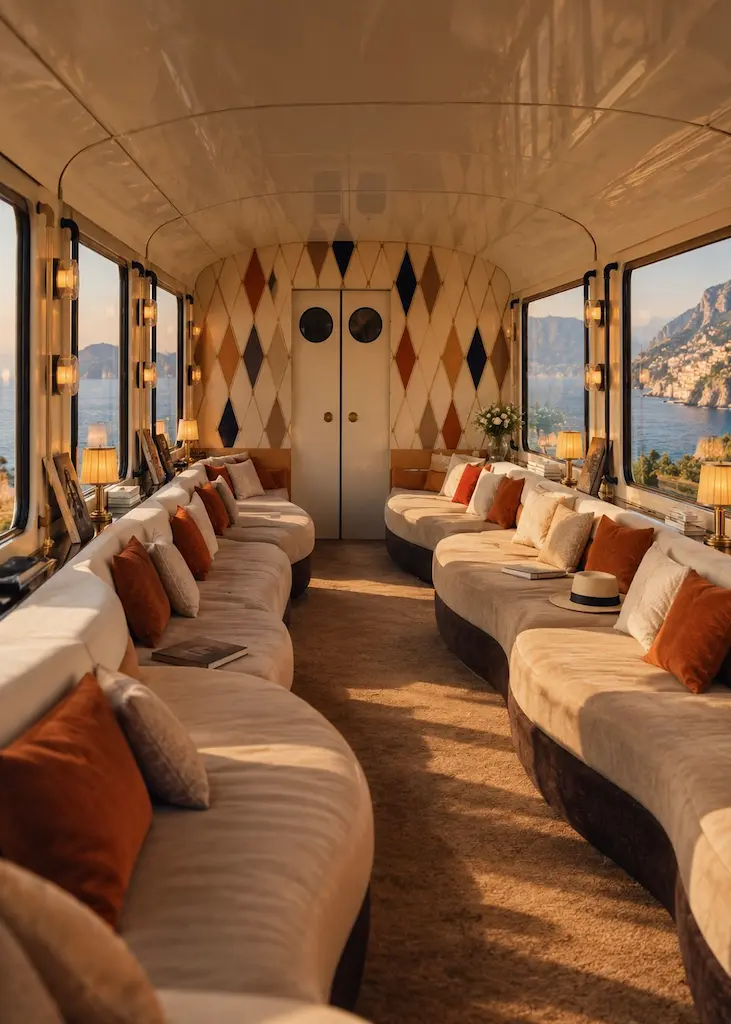
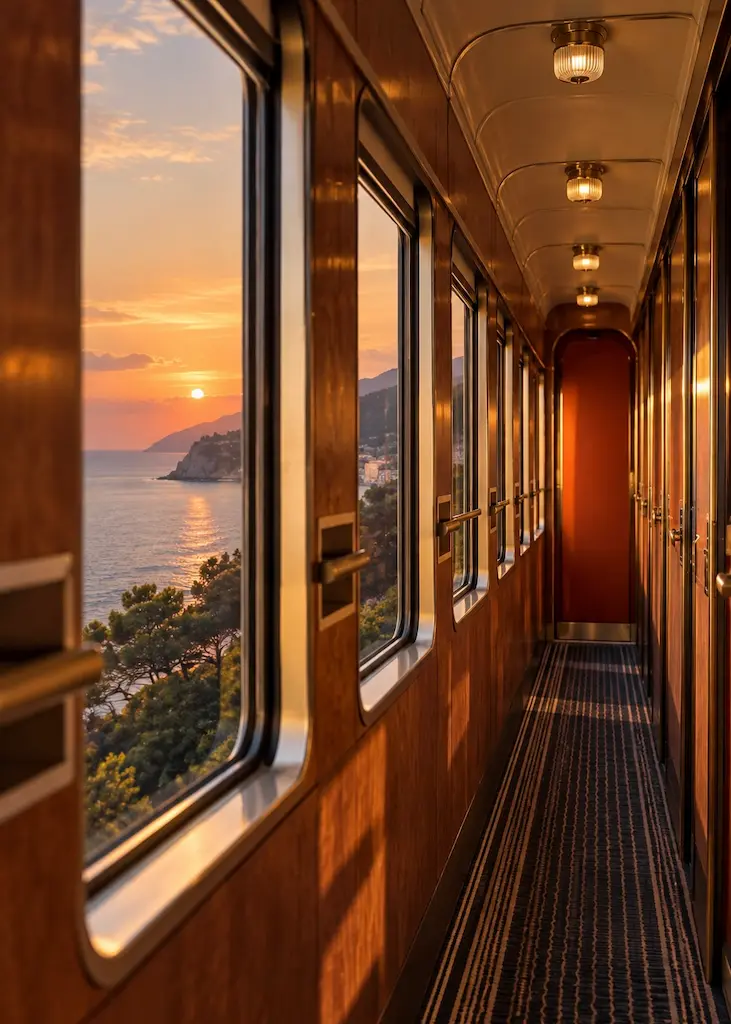
But if an ordinary regional train leaves you wondering what happens when someone adds polished interiors, proper dinners, private cabins and several days to the equation, Italy of course has an answer. La Dolce Vita Orient Express turns the idea into a five-day affair, trading the paper cup and station sandwich for a rather more sophisticated interpretation of slow travel. It is a different proposition—and certainly a different budget—but perhaps the same instinct lies beneath both: surrender the road, settle beside the window and allow Italy to come to you. Sometimes luxury is simply not driving; sometimes, apparently, it also comes with dinner.
ESCAPE NOTES
Plan the Journey: Check current schedules and book directly with Pacific Surfliner for California, SNCF Connect for Marseille–Nice, and Trenitalia for Liguria, Sicily and Calabria. Regional schedules can change seasonally, so confirm your exact train before traveling.
What Makes This Special: These are mostly ordinary working railways, not sightseeing trains. That is precisely the point: extraordinary coastlines without the choreography of luxury rail.
Don’t Miss: The Pacific Surfliner between San Diego and San Clemente and north of Ventura; Antibes between Marseille and Nice; Camogli or Sestri Levante from Genoa; Cefalù from Palermo; and Maratea or Calabria on the long journey south.
Taste: Granita with brioche in Sicily or tartufo if the journey takes you through Pizzo.
Shop: Ligurian olive oil, Sicilian almond sweets or a small piece of local ceramics—something that can survive a train journey without requiring its own seat.
Best Time: Late spring and early autumn, when the days are long, the sea is luminous and considerably fewer people are attempting to have exactly the same idyllic coastal experience.
Coastal ESCAPES — Travel through the senses, one shoreline at a time.
CONTINUE EXPLORING
Inspired by this story? The story continues. Here is your next read A Luxury Room with a 24-Hour View →