The Art Beneath Your Feet
Every beautiful room encourages us to look around. The furniture catches our attention. The artwork draws our eyes upward. Sunlight pours through the windows. We notice the colours, the fabrics, and the carefully chosen objects collected over a lifetime. Rarely do we stop to look down at the floor tiles.
Yet for more than two thousand years, the civilizations around the Mediterranean treated the floor as one of the home’s greatest works of art. Long before gallery walls, designer lighting, or statement furniture, there were floors that told stories—crafted from stone, marble, clay, pebbles, and ceramic by artisans whose work wasn’t meant to hang on a wall, but to be lived with every single day.
After Walking Barefoot, it feels only natural to ask another question. What exactly have we been walking on all this time? Somewhere along the journey to modern living, we decided the floor should become almost invisible. Kitchens became statement pieces, sofas became investments, and lighting became sculpture. Even the humble coffee table acquired celebrity status. Meanwhile, the floor quietly accepted a supporting role, despite being the one surface every beautiful object depends upon.
When the Mediterranean Floor Tiles Were the Artwork
Of all the places to display artistic talent, why choose the one everyone walks across? The answer is surprisingly practical. Furniture could be replaced, walls could be repainted, but the floor remained. It welcomed every visitor and was one of the few parts of a house designed to last for generations. A beautifully crafted floor tiles reflected local materials, skilled artisans, and often the prosperity of the household. It wasn’t simply decoration. It was architecture.
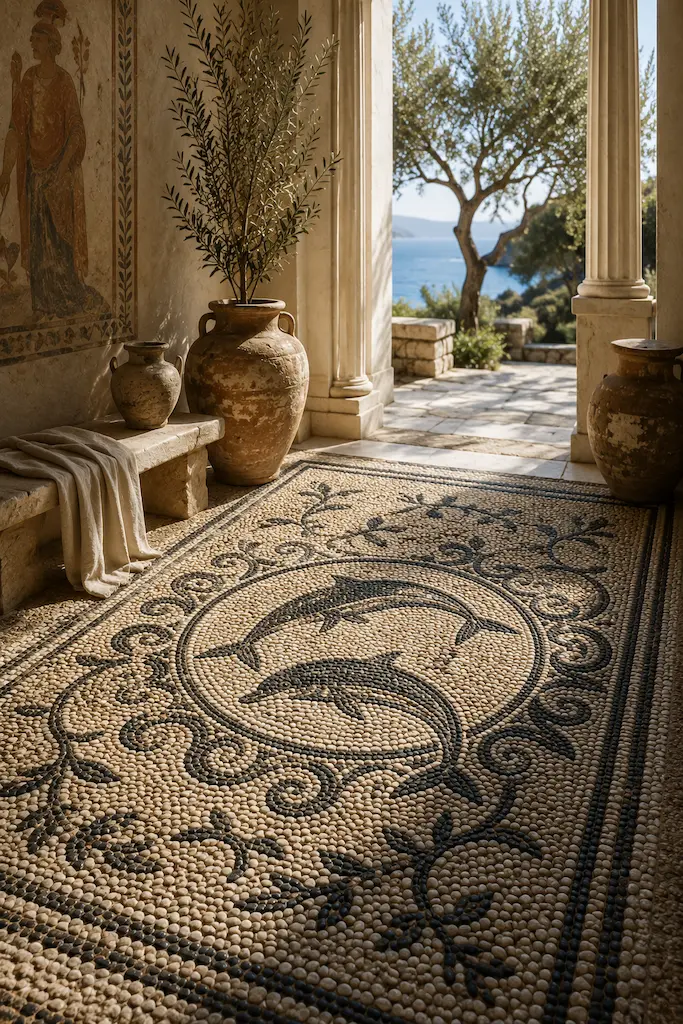
The earliest decorative floors appeared in ancient Greece, where craftsmen arranged smooth river pebbles into mosaics depicting dolphins, vines, waves, and scenes from mythology. The Romans admired the idea and, being Romans, decided to scale it up considerably. Pebbles gave way to precisely cut pieces of marble and coloured stone known as tesserae, transforming villas, temples, and bathhouses into galleries beneath people’s feet. From Greece and Rome, decorative flooring traditions spread throughout the Mediterranean, evolving differently in every region. While paintings faded and furniture disappeared, many of these tile floors quietly survived. Perhaps that was always the point.
Spain
Where Floors Replace Rugs
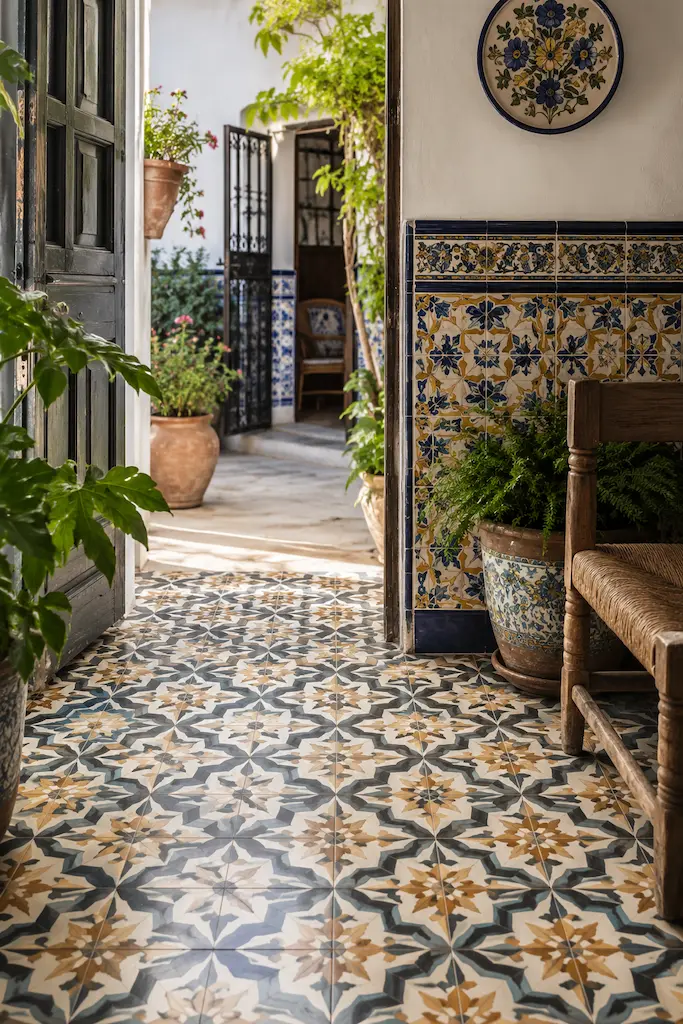
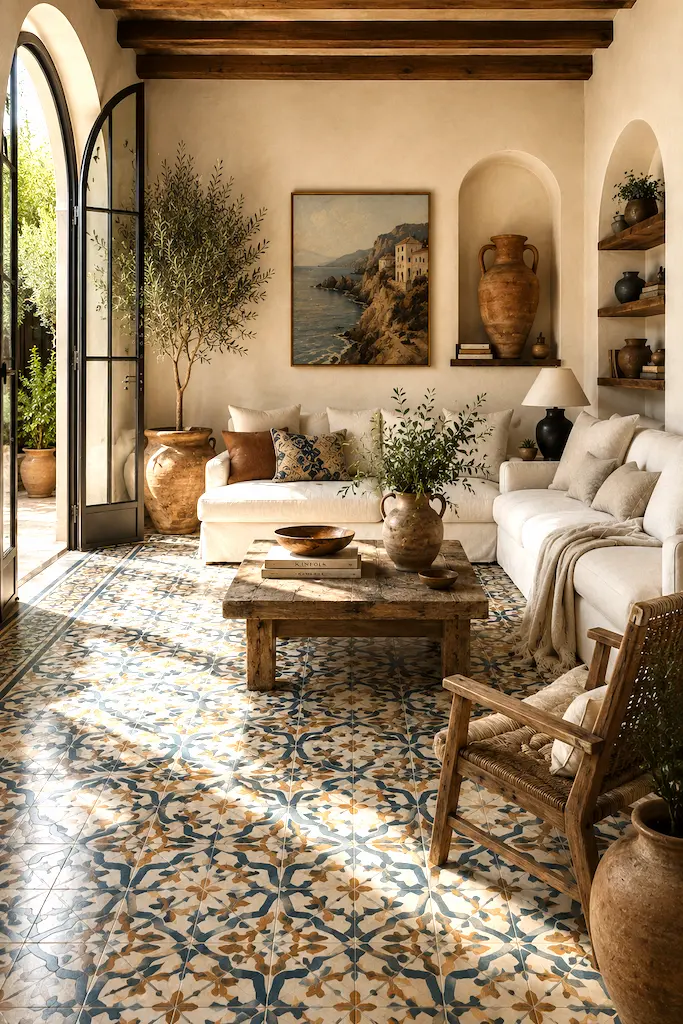
Spain never really believed a floor should stay quiet. Roman craftsmanship blended with centuries of Islamic and Moorish influence to create some of Europe’s most recognisable decorative floors. Geometric patterns, colourful ceramics, and later hydraulic cement tiles transformed entrances, kitchens, and courtyards into permanent works of art. One tile on its own appears modest. Place hundreds together and the floor becomes a permanent rug that never needs rolling out. That is why traditional Spanish interiors feel so welcoming. The room doesn’t begin at eye level—it begins beneath your feet.
Greece
Beauty Found in Simplicity
If Spain celebrates pattern, Greece celebrates material. Traditional Greek homes rely on marble, limestone, terracotta, and pebble mosaics that echo the surrounding landscape rather than compete with it. The earliest decorative pebble floors appeared here more than two thousand years ago, yet they still feel remarkably modern. Their beauty comes not from perfection but from texture, light, and the quiet confidence of natural materials. A Greek floor doesn’t demand attention. It rewards it.
Italy
Every Region Tells a Different Story
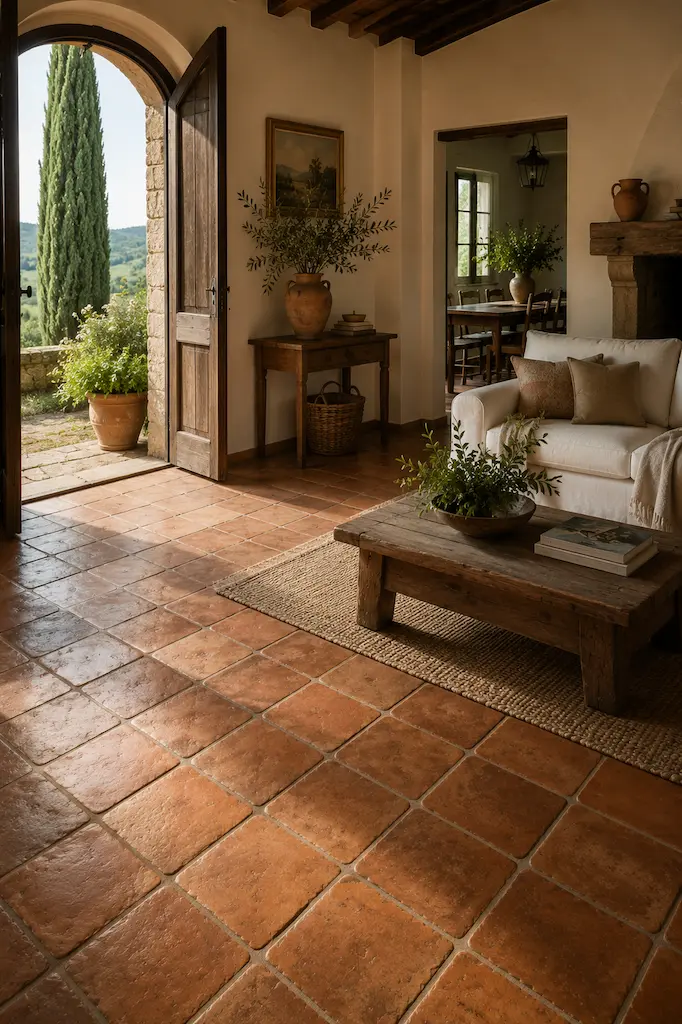
Italy rarely agrees with itself, and its floors are no exception. Tuscany is known for warm terracotta that grows richer with every passing decade. Along the Amalfi Coast and throughout Sicily, colourful majolica tiles bring citrus groves, gardens, and Mediterranean sunlight indoors. Every region developed its own character, proving there is no single Italian way of building a home.
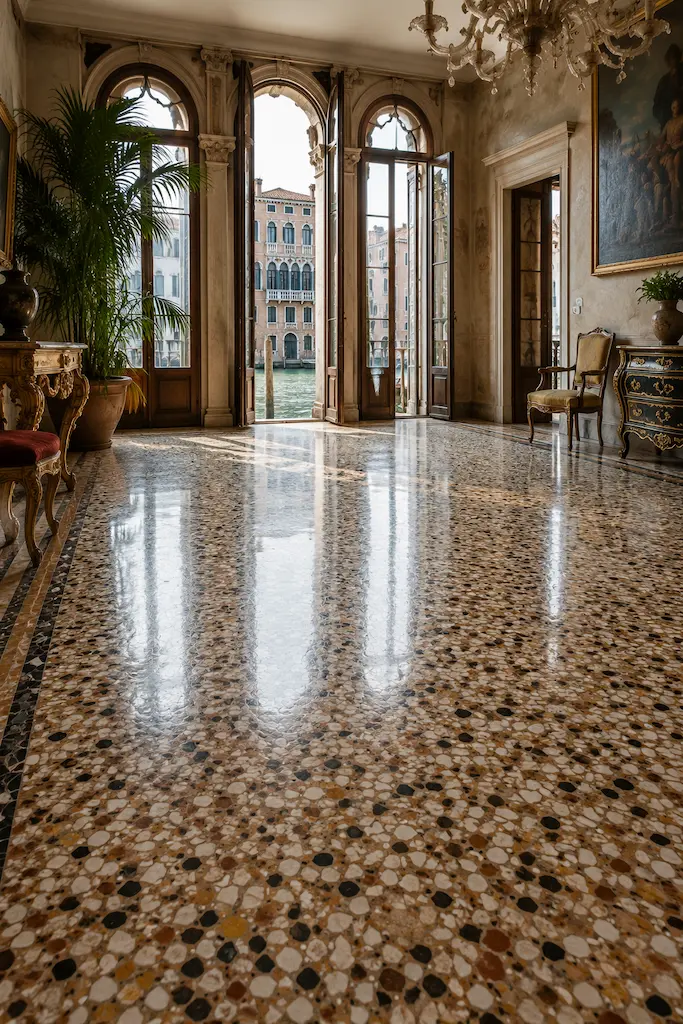
Then there is Venice. Perhaps nowhere in Europe has a floor become quite so iconic. Venetian terrazzo began as an ingenious way of reusing fragments of marble left behind by stone cutters. Embedded into lime mortar and polished until they shimmered, those small offcuts became one of Italy’s greatest design traditions. It was recycling centuries before anyone thought of the word. As afternoon light moves across an old Venetian palazzo, the polished terrazzo almost resembles the canals outside. Sometimes the most beautiful ideas begin with what others might have thrown away.
Turkey
Geometry and Tradition
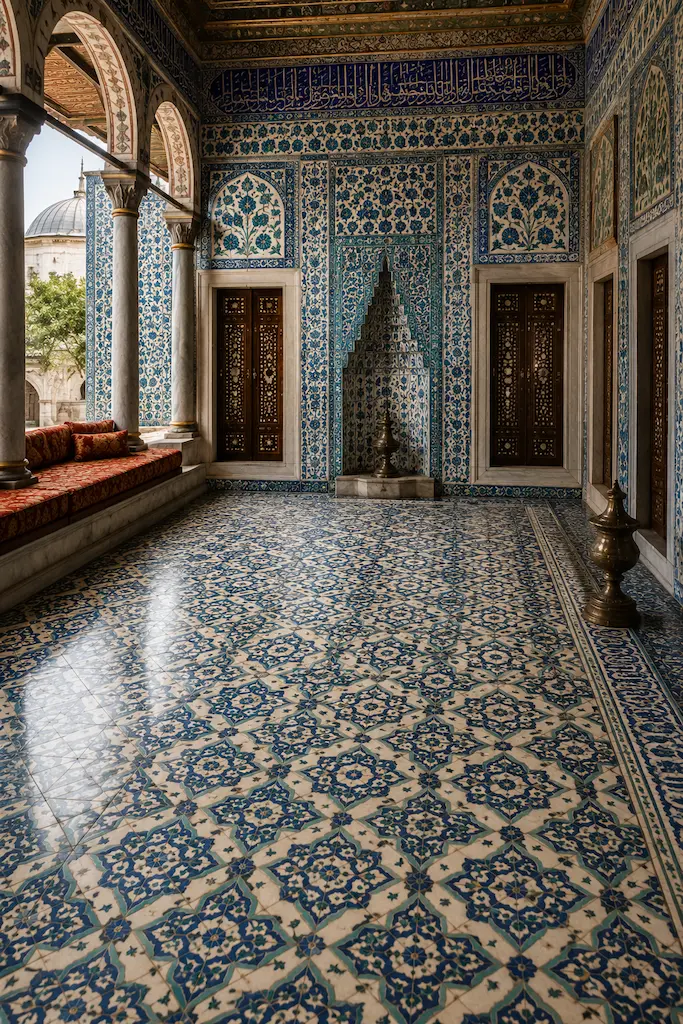
Turkey reminds us that a floor was never expected to work alone. Influenced by Byzantine and Ottoman craftsmanship, geometric patterns, richly coloured ceramics, mosaics, and natural stone created interiors where walls, floors, arches, and ceilings all spoke the same language. Every surface contributed to the atmosphere, creating rooms that felt carefully composed rather than simply decorated. Walking through a traditional Turkish home, the floor isn’t merely supporting the architecture. It is participating in it.
The Floor as a Work of Art
Looking across the Mediterranean, one idea quietly connects them all. The floor was never expected to disappear. It reflected local clay, nearby quarries, regional craftsmanship, and centuries of accumulated knowledge. Long before interior design became a profession, the floor already expressed the identity of a place. Spain spoke through pattern. Greece through stone and light. Italy through regional craftsmanship. Venice through polished terrazzo. Turkey through geometry and colour.
That is why these homes still feel so complete today. Nothing is pretending to be something else. Terracotta proudly remains clay. Marble happily admits it is stone. Terrazzo celebrates fragments rather than hiding them. The Mediterranean didn’t invent beautiful floors. It simply refused to treat them as an afterthought.
When Did We Stop Looking Down?
Modern flooring is, without question, practical. It’s durable, comfortable, easy to maintain, and designed for contemporary living. There is nothing wrong with that. Yet somewhere during the last century, our relationship with the floor quietly changed. Efficiency replaced artistry. Uniformity replaced regional identity. Floors became something to install rather than something to admire.
Historic Mediterranean homes took the opposite approach. Stone looked like stone. Clay looked like clay. Marble looked like marble. They never tried to disguise their materials—they celebrated them. Perhaps that is why these homes continue to feel so memorable. Not because they are more luxurious, but because they are more honest.
The next time you find yourself wandering through an old Mediterranean home, resist the temptation to admire the ceiling first. Look down. Better yet, remove your shoes. Feel the coolness of marble, the warmth of sun-baked terracotta, the smoothness of Venetian terrazzo, or the tiny imperfections left by a craftsman’s hand centuries ago. Notice how the floor changes the room before you’ve even looked at the furniture.
Mediterranean homes have quietly encouraged this awareness for generations. They remind us that beauty doesn’t always hang on a wall or sit upon a shelf. Sometimes it lies beneath our feet, patiently carrying the footsteps of countless generations while turning the simple act of crossing a room into an encounter with centuries of craftsmanship.
If you enjoyed this article, you may also like Coastal Homes And the Lost Art of Craftsmanship →