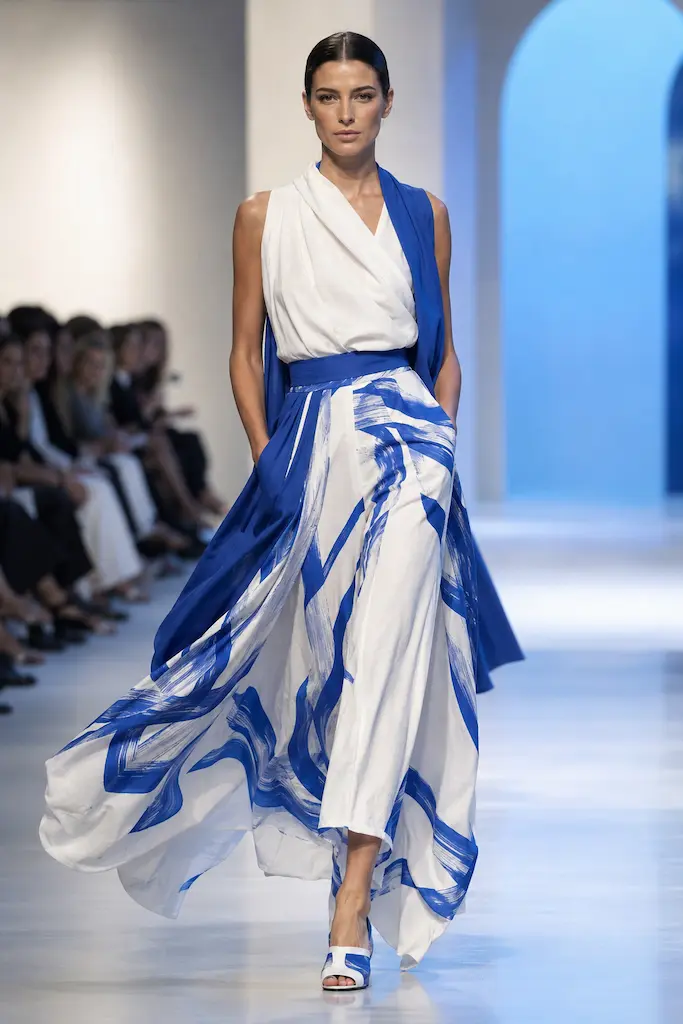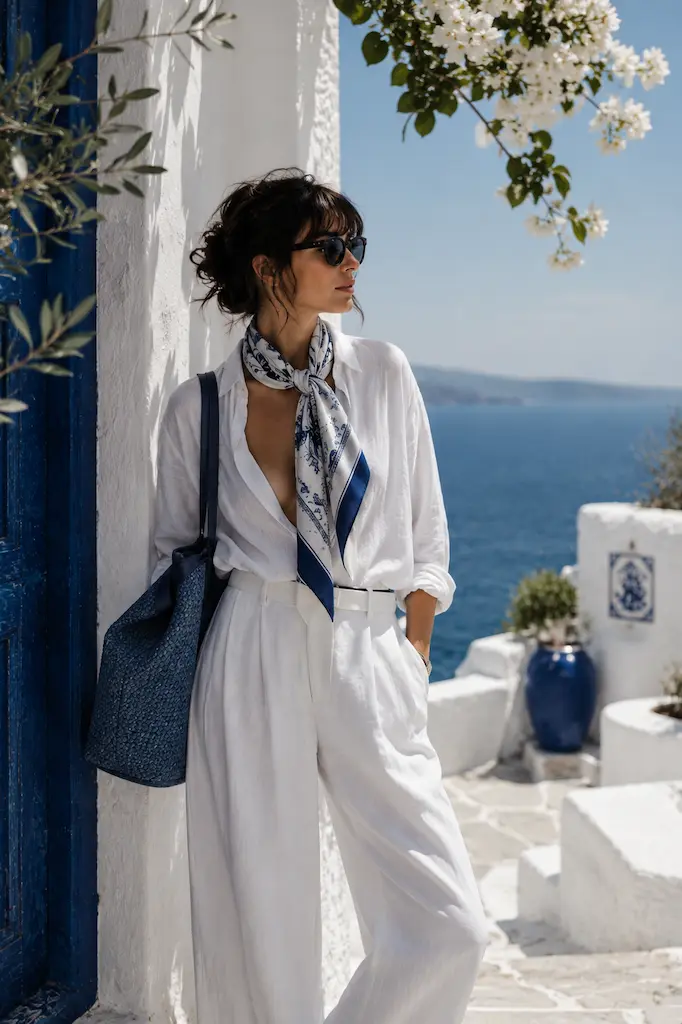
From ancient Greek draping to California casual, why dressing with ease is an idea that never goes out of fashion.
California is cheating, and it just got caught. For decades, the Golden State has enjoyed a reputation for dressing effortless. As though getting dressed requires almost no effort at all. Jeans, a white T-shirt, a loose linen shirt, flat sandals, perhaps a wrap thrown over the shoulders when the ocean breeze arrives. The result is comfortable, uncomplicated and suspiciously good-looking. The ancient Greeks might like a word.
More than 2,500 years before California turned casual dressing into something approaching a cultural philosophy, the ancient Greeks had already mastered an intriguing idea: beautiful clothing does not always require complicated construction. Sometimes the cleverest thing you can do with fabric is let it fall, fold, wrap or gather around the body.
California would eventually arrive at its own version of dressing freely, although by a very different route. The resemblance is worth investigating, if only because the Greeks managed it without inventing the sweatshirt.
The Greeks understood the drape
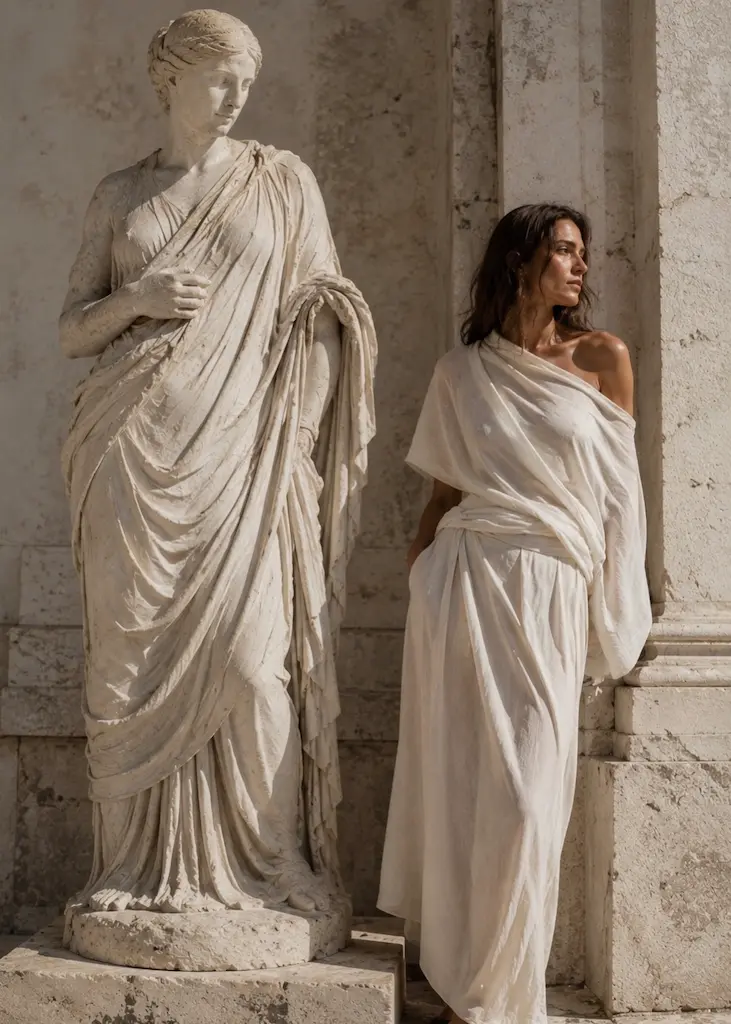
Ancient Greek clothing could be remarkably simple in construction, although certainly not always simple in appearance. Three principal garments—the chiton, peplos and himation—were based on lengths of woven cloth that could be fastened, folded or wrapped around the body. As the Metropolitan Museum of Art explains, the chiton could be made from rectangular fabric panels, the peplos from a folded rectangle secured at the shoulders, and the himation from a large rectangular cloak. No invisible zippers, complicated tailoring or garments requiring an engineering degree to escape.
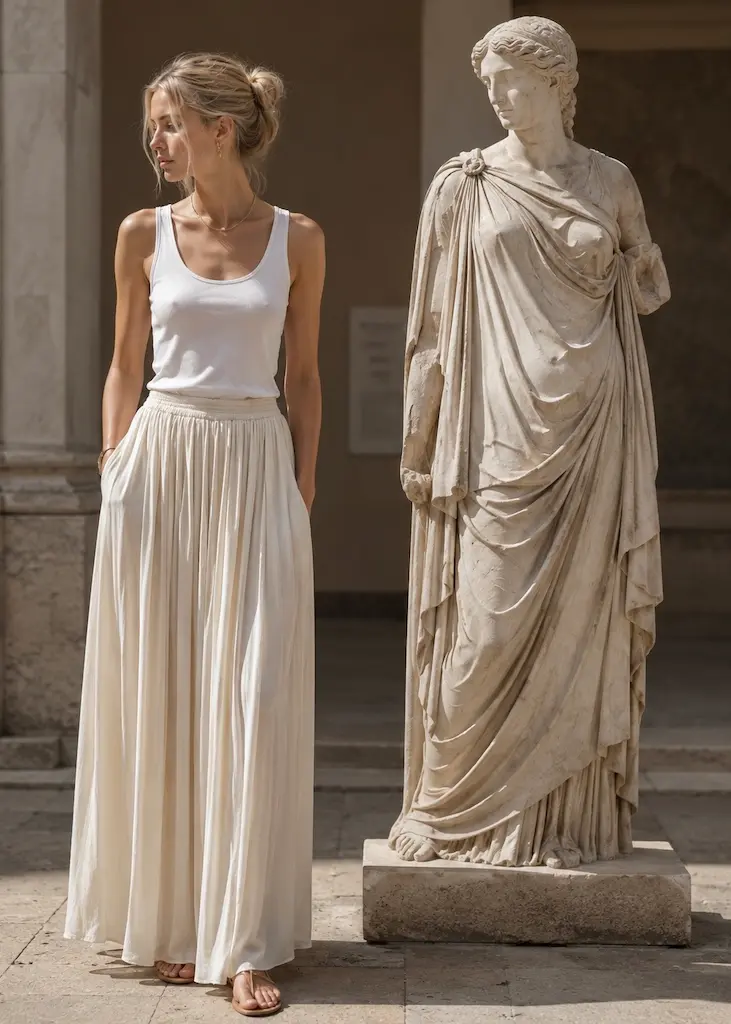
The sophistication was in the arrangement. A fold created volume, a belt changed proportions, and a pin could transform the neckline. The wearer participated in creating the silhouette, while movement continually changed the way the fabric fell. Greek sculptors understood this beautifully, carving marble garments that appeared almost impossibly fluid. One fourth-century BCE sculpture at the Met distinguishes the finer texture of a chiton from the heavier folds of a himation.
There is, however, a small complication with the popular image of ancient Greece. Those pristine white garments we associate with classical statues are only part of the story. Greek clothing could be colorful, patterned and decorated, as ancient paintings and surviving traces of pigment reveal.
The modern minimalist wardrobe may admire Greece for its restraint, but history was considerably less interested in obeying a neutral color palette.

California invented its own kind of freedom
California’s fashion identity was not born from draped robes or a fascination with classical sculpture. It grew from denim, sportswear, swimwear, Hollywood and a lifestyle in which people moved between work, recreation and the outdoors. By the 1930s and 1940s, the state’s growing sportswear and swimwear industries were helping redefine American casual dressing.
California didn’t simply make clothing less formal; it helped make informality desirable. That is quite an achievement for a place where a perfectly respectable outfit might consist of jeans and a shirt that has never encountered an iron.
The California wardrobe also developed a practical intelligence of its own. Separates could be mixed, layers added or removed, and clothing adapted to an afternoon that might involve errands, lunch, walking and the beach. Its effortless reputation comes less from a particular garment than from the refusal to treat every change of occasion as a reason to change clothes. This is where California becomes interesting beside the Mediterranean: not because their wardrobes are identical, but because both developed ways of dressing around how people actually live.
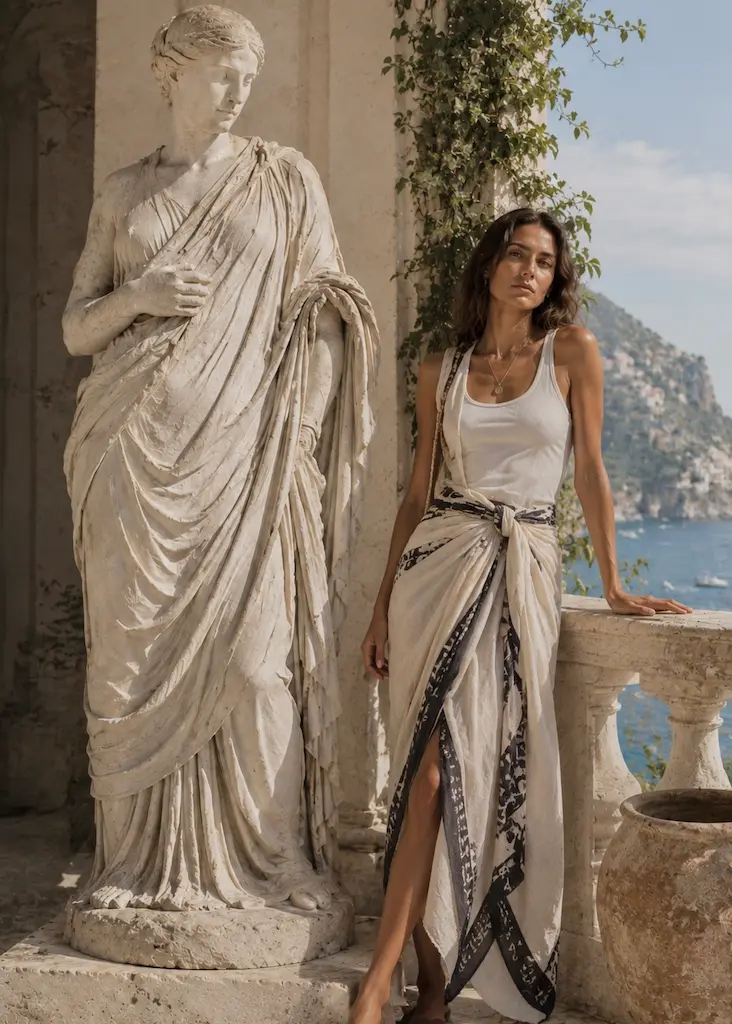

When ancient ideas become modern fashion
Of course, classical Greek dress did influence later fashion more directly. The flowing Empire silhouette of the early nineteenth century consciously recalled ancient forms, while twentieth-century designers repeatedly returned to pleating, asymmetry and sculptural draping. The Metropolitan Museum of Art documents how the chiton, peplos and himation continued to inspire Western dress long after antiquity.
Fashion has a remarkably long memory, even when it prefers to announce everything as new.
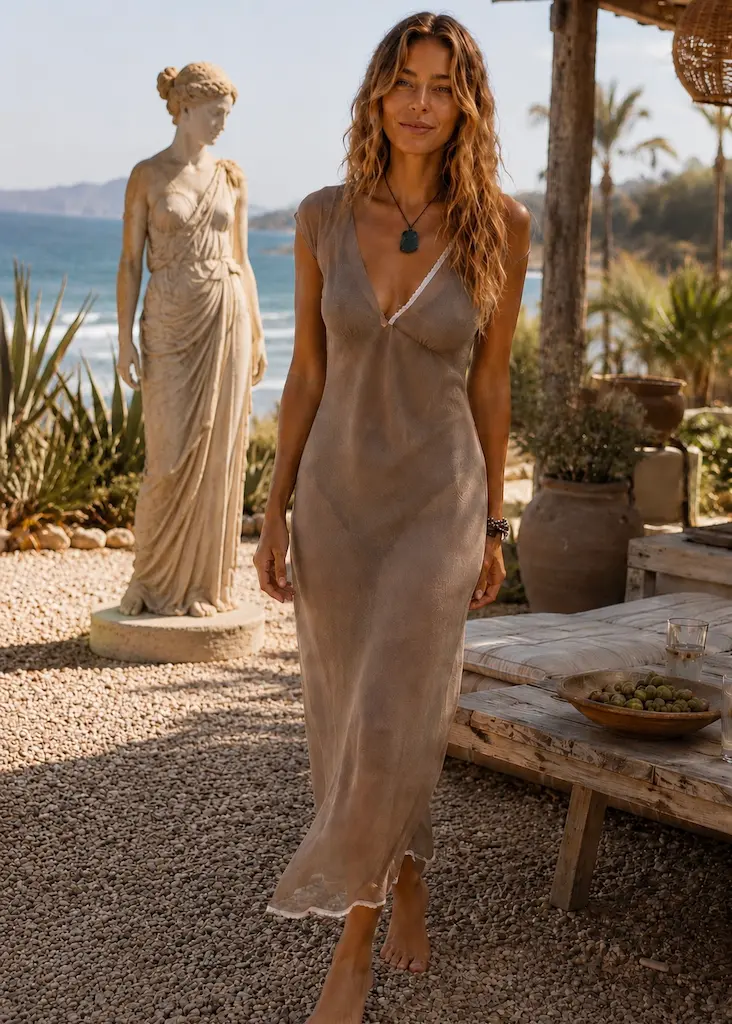
In contemporary California, the connection is more a matter of design philosophy than proven ancestry. Los Angeles labels such as James Perse have made soft jerseys, understated basics and relaxed layers desirable, while Raquel Allegra explored draping, texture and fluid silhouettes. Neither is dressing modern Californians as ancient Greeks. Yet both demonstrate how thoughtful construction can make clothing feel natural, adaptable and surprisingly sophisticated.

Two coasts, one enduring idea
Here is where the comparison becomes more interesting than a resemblance between dresses. Ancient Greek draping and California casual emerged from very different societies, with different customs, materials and expectations. What they share is an understanding that clothing can accommodate the body rather than continually discipline it. Warm weather, outdoor life and the practical business of moving through a day can all encourage garments that are adaptable and comfortable. These ideas are hardly exclusive to either place, but each culture gave them a distinctive expression.
That is the real secret of effortless style. It isn’t necessarily about wearing less, looking undone or pretending you haven’t thought about your clothes. It is about eliminating unnecessary complication without eliminating beauty. The ancient Greeks explored that possibility through the art of the drape; California developed its own version through casual sportswear and the freedom to move between occasions. Different centuries, different wardrobes, but the same enduring idea: the best clothes allow us to move freely, live comfortably and still look beautifully dressed.
So, did ancient Greece invent California’s effortless style? Not quite. But the Greeks understood something that California would eventually make central to its own fashion identity: clothing can look considered without feeling restrictive. The Golden State made casual dressing a modern aspiration. The Greeks had already shown how much could be accomplished with a piece of fabric and a little imagination. They just didn’t have Malibu.
CONTINUE EXPLORING
Inspired by this story? The story continues. Here is your next read Why Coastal Towns Never Stopped Wearing Breton Stripes →