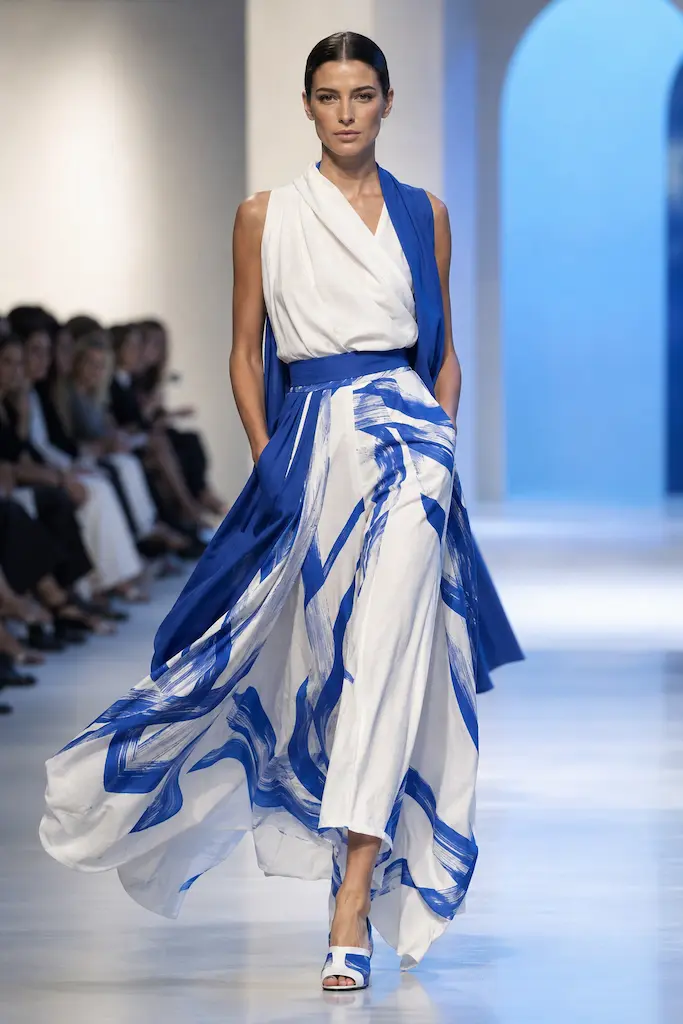
The Fabric For Both Mediterranean and California Coasts


Linen has an unfair advantage in summer: it behaves as though heat were part of the design brief. That sounds obvious now, after years of resort collections and pale linen dresses drifting through hotel campaigns, but linen earned its reputation long before anyone decided it looked expensive beside a pool. Made from flax, it is one of the oldest textiles still in regular use, valued for thousands of years because it worked in warm climates. Fashion arrived much later and, as usual, took credit for noticing.
The reason linen feels so convincing by the coast is not mystical. It is physical. Linen fibers are strong, absorb moisture efficiently, release it relatively quickly, and do not cling to the body in quite the same way as many softer, denser fabrics. A loosely woven linen garment allows air to move, which is exactly what one wants when the day involves sun, salt, pavement and the regrettable realization that shade is three streets away.
This is also why the linen dress makes more sense than its reputation as a “vacation piece” suggests. It is not useful because it looks relaxed. It looks relaxed because the fabric performs best when it is given room to move. A full or loosely cut dress creates space between cloth and skin. The longer silhouette can also provide more coverage from direct sun without necessarily making the wearer hotter, provided the weave, weight and cut remain breathable. That distinction matters. A heavy, tightly woven linen sack will not become comfortable simply because someone has photographed it in Santorini.
The best linen dresses work because they cooperate with the conditions rather than fighting them: dry heat, shifting breezes, strong sun, cooler evenings and days that move repeatedly between indoors and outside. That is already enough reason for linen to belong in a Caliterranean summer wardrobe. No mythology required.


The Mediterranean connection is historical, but it should not be simplified into “linen was invented by the Mediterranean.” Flax textiles have an ancient history extending through Egypt and other parts of the Near East before linen became deeply embedded in European textile production and everyday clothing. What matters for this story is that generations of people living in hot climates understood something fashion sometimes forgets: fabric choice is architecture for the body.
Shade matters in a house. Air circulation matters in a room. Materials determine how heat is absorbed and released. Clothing follows the same logic. This may be one of the more useful connections between Mediterranean and California coastal life. The architecture is different. The histories are different. The wardrobes are certainly not identical. But both regions spend long periods negotiating bright sun, dry warmth, cool coastal air and an outdoor life that makes overly complicated dressing feel increasingly absurd.
Southern California learned this lesson particularly well. A summer day may begin beneath marine cloud, become unexpectedly hot by noon and end with enough wind off the Pacific to make yesterday’s sleeveless optimism seem premature. Linen handles that instability rather elegantly because it layers without becoming visually heavy. A loose linen dress works alone when it is warm, under a cotton shirt when the air cools, or beneath a light knit later without turning the entire outfit into seasonal negotiations.
And then there are the wrinkles. For decades, clothing technology has devoted considerable effort to eliminating creases. Linen responded by turning them into part of the aesthetic. This is not entirely an accident. Linen fibers have relatively low elasticity, meaning they do not spring back from bending as readily as some other fibers. Hence the creasing. What would be considered a flaw in many textiles became one of linen’s identifying qualities.
There is something satisfying about that reversal. A sharply pressed linen dress can be beautiful, but five hours later it will reveal exactly where its wearer sat, walked, leaned and lived. The garment records the day with alarming honesty. Luxury fashion somehow managed to make this desirable. For once, perhaps rightly.
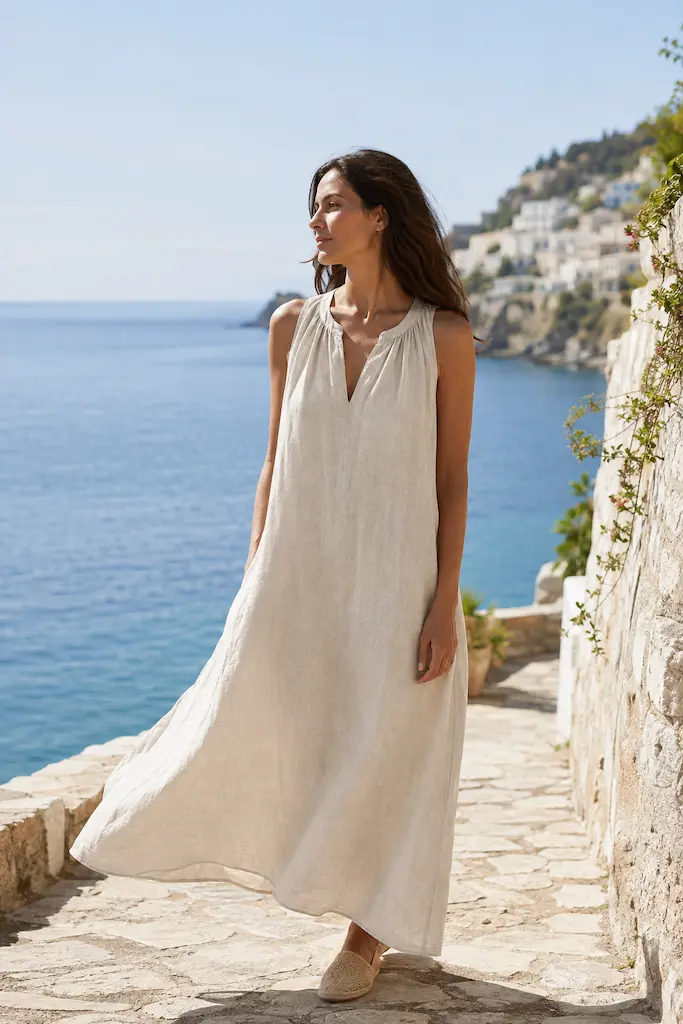

The linen dress also solves a problem that appears repeatedly in coastal wardrobes: what do you wear when the day refuses to remain one thing? Formal summer clothes can feel ridiculous at ten in the morning. Extremely casual clothes can feel equally wrong by dinner. The linen dress sits somewhere between the two because the fabric itself carries both associations. Linen has been household cloth, work cloth, fine cloth, tailoring material and resort wear. It does not arrive with one fixed level of ceremony.
That makes styling simpler, but not because the dress magically “goes everywhere.” Context still exists, despite what capsule-wardrobe marketing occasionally suggests. What linen does particularly well is tolerate understatement.
A flat espadrille, woven shoe, canvas sandal, simple jewelry, cotton layer or structured textile bag is often enough. The point is not to accessorize linen into sophistication. It already has enough surface, movement and irregularity to hold attention on its own.
This is also where the Caliterranean wardrobe should differ from the familiar fantasy of “Mediterranean style.” The goal is not to assemble a costume of white linen, straw hat, basket and picturesque doorway and then spend the afternoon desperately searching for an olive grove. It is to understand why certain materials repeatedly make sense near the coast.
Linen does because it breathes, layers easily, tolerates heat, softens with use and looks better when it stops trying to appear untouched. The dress simply gives those qualities room to work. Perhaps that is why linen survives so many attempts to make summer dressing more complicated. Every season brings another technical fabric promising remarkable moisture management, cooling technology or some proprietary innovation whose name contains suspiciously many capital letters.
Linen has flax. And several thousand years of evidence. That seems competitive enough.
CONTINUE EXPLORING
Inspired by this story? Continue your journey with The Summer of White →