
What a broken piece of glass can teach us about the remarkable ability of the sea to soften our edges without changing who we are.
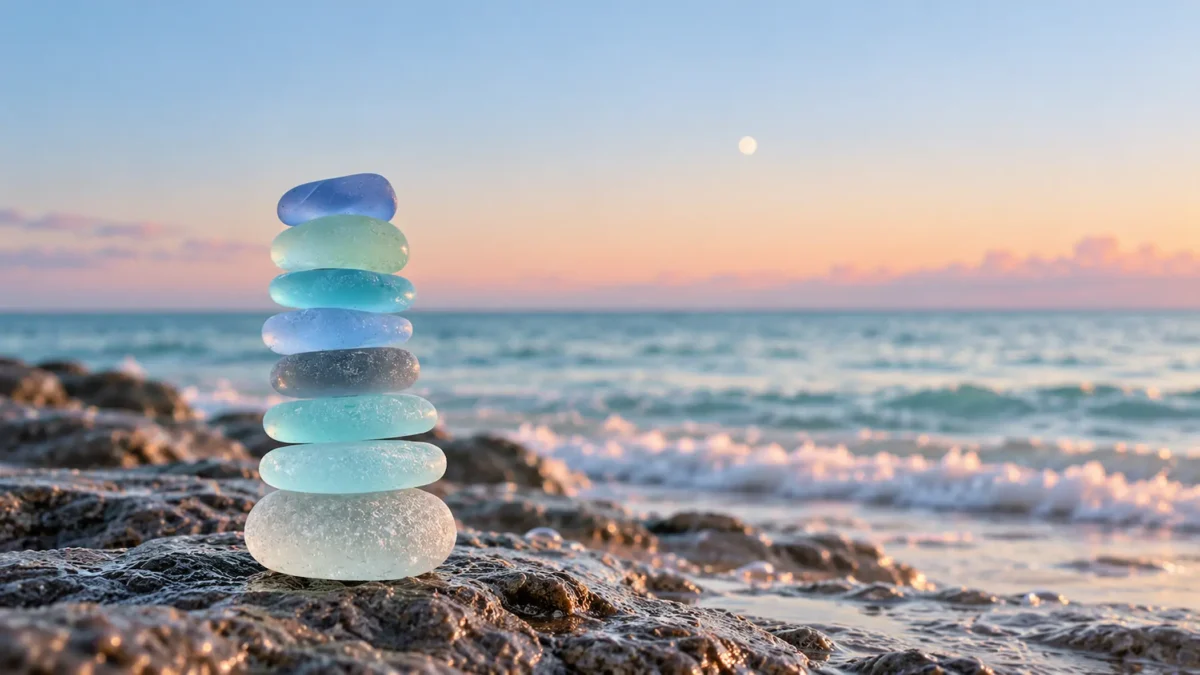
There is something rather extraordinary about sea glass. What begins as a discarded piece of something ordinary—a bottle, a window, perhaps a glass that once held someone’s afternoon drink—eventually becomes an object people search for, collect, and occasionally display as though it were a precious stone. The transformation is so complete that we rarely consider its rather unglamorous beginnings. After all, nobody walks along a beach hoping to discover a particularly attractive piece of broken bottle.
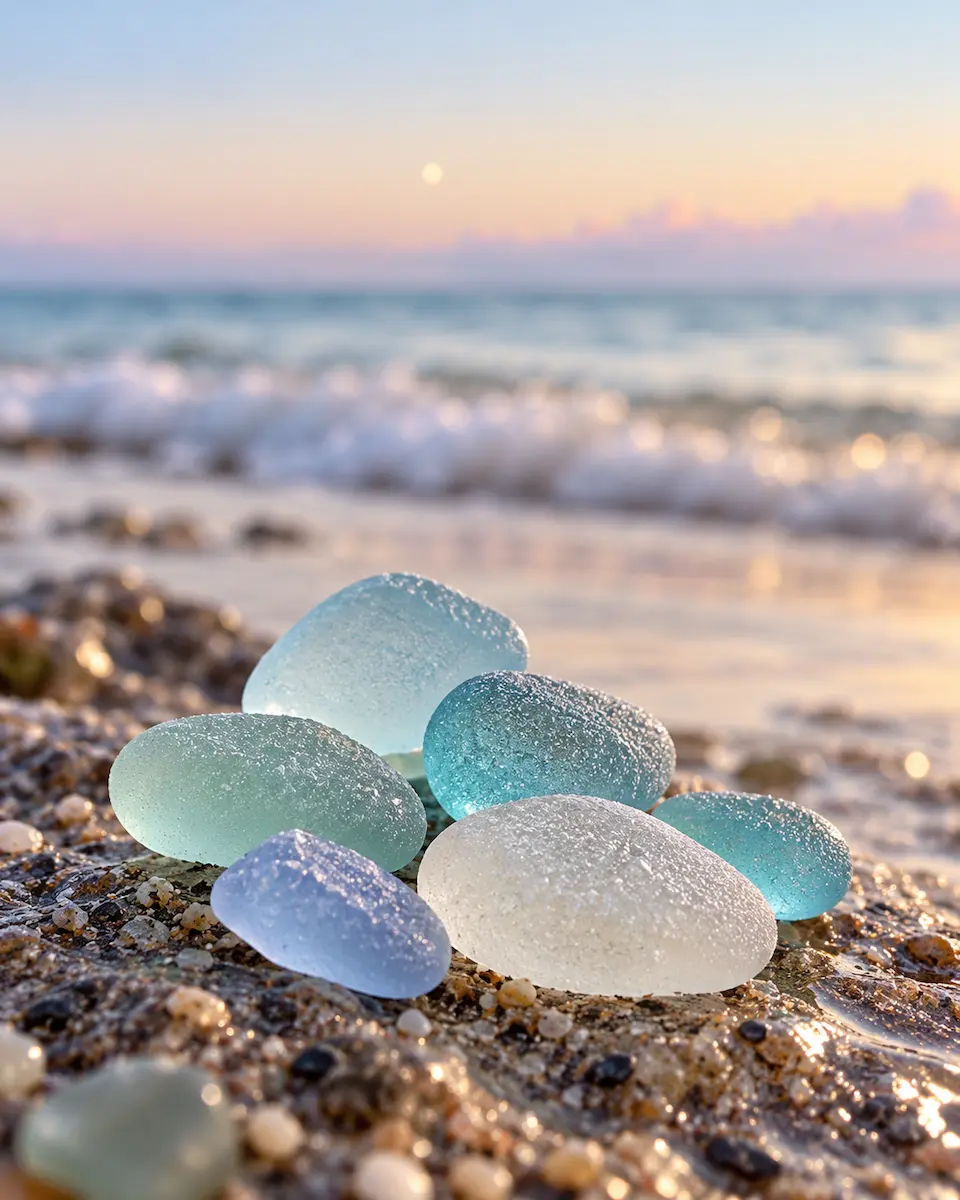
Yet that is precisely what sea glass is. A fragment that entered the ocean with sharp edges and a rough history, only to emerge years later smooth, frosted, and unexpectedly beautiful. The waves have worn away its sharpness, but something important remains: its color, its substance, its identity. A piece of green glass does not become blue simply because the ocean prefers it that way.
And perhaps there is something wonderfully familiar about that.
We arrive at the sea carrying our own collection of sharp edges. Irritation from an argument, anxiety about tomorrow, frustration with yesterday, or the peculiar exhaustion of living in a world that expects us to respond to everything immediately. We are not necessarily unhappy people. Sometimes we are simply people who have spent too much time being knocked against the hard surfaces of everyday life.
Then we reach the water, and something begins to change.
The ocean has a way of making us less difficult
Consider the peculiar behavior of otherwise perfectly reasonable adults at the beach. People who cannot sit through a five-minute conversation without checking their phones will spend half an hour watching waves arrive and disappear. Someone who spent the morning complaining about traffic, deadlines, and humanity in general suddenly becomes remarkably agreeable after walking barefoot along the shore. Even silence, which can feel uncomfortable in a crowded room, becomes something we willingly seek beside the sea.
The ocean has not solved anybody’s problems. The overdue bills are still overdue, the difficult conversation still needs to happen, and the inbox has almost certainly become worse in our absence. Yet the problems seem to occupy a slightly smaller portion of our minds. We have not become different people; we have simply become less consumed by everything demanding our attention.
Marine biologist Wallace J. Nichols spent years exploring this relationship between water and the human mind. In his influential book Blue Mind, published in 2014, he described the calm, gently meditative state that people can experience when they are near, in, or around water. His work brought together neuroscience, psychology, environmental research, and something humanity had suspected long before scientists began studying it: water often makes us feel better.
Nichols gave this experience a name. But perhaps the more interesting question is not simply why the sea makes us feel calmer. It is what happens to us when that calm becomes a regular part of our lives.


The science of doing absolutely nothing
The human mind is remarkably talented at finding things to worry about. Give it a quiet afternoon and it may reward you with a detailed inventory of unfinished responsibilities, awkward conversations from three years ago, and several future disasters that have yet to occur. Our surroundings rarely help. Notifications, traffic, screens, and competing demands create an environment in which attention is constantly being borrowed, interrupted, and borrowed again.
Water offers an unusual alternative. It moves constantly without appearing hurried. Waves create a recognizable rhythm, yet no two arrivals are quite identical. The horizon gives our eyes somewhere to rest without asking them to focus on anything particularly important. There is just enough happening to hold our interest and not so much that we feel obliged to do something about it.
Psychologists studying restorative environments use the term soft fascination to describe the effortless attention that certain natural settings can encourage. Nichols connected this concept to water, suggesting that watching its movement can hold our interest while allowing some of the mental demands of everyday life to recede. It is a rather elegant arrangement: the ocean keeps us entertained without needing us to participate.
There is also research suggesting that the benefits extend beyond pleasant seaside impressions. A 2013 study led by environmental psychologist Mathew White at the University of Exeter found that people in England reported slightly better general and mental health when living closer to the coast, even after researchers accounted for several individual and neighborhood factors. The associations were modest, and the study did not establish that proximity to the ocean alone caused better health. Nevertheless, it offered evidence that the relationship between coast and well-being deserves to be taken seriously.
The sea, it seems, may be doing something useful while appearing to do absolutely nothing.

What the waves take away, and what they leave behind
Here is where the sea glass becomes particularly interesting. Its transformation is not the result of one spectacular wave. It happens through repetition, as water, sand, and small stones gradually abrade its surface. No single encounter creates the finished piece. The beauty comes from accumulated contact with its environment, from a process so slow that we cannot observe it happening in any meaningful way.
Our emotional lives may work in a similar fashion, although the comparison is a metaphor rather than a scientific theory. A single afternoon at the beach is unlikely to transform a lifelong tendency toward impatience. But what about hundreds of afternoons? Years of seaside walks, morning swims, lunches overlooking the harbor, or simply finding a quiet place to watch the water? Perhaps the value lies less in an occasional dramatic escape and more in the gentle repetition of being somewhere that asks very little of us.
A 2019 systematic review of activities in and around blue spaces found encouraging evidence for psychological and social well-being, while also emphasizing the need for stronger research. More recently, a 2026 review of 139 studies found that researchers still cannot reliably determine which types of water environments, or which particular features, provide the greatest mental-health benefits. The evidence supports a promising relationship, not a universal prescription.
That distinction matters. The ocean cannot promise to turn an irritable person into a permanently serene one. Nor should it. A completely polished personality might be rather dull company, and occasional irritation is not necessarily something we need to eliminate. The more appealing possibility is that regular encounters with restorative environments may give us opportunities to respond with greater ease.
Sea glass, after all, does not lose everything that makes it recognizable. Its edges become gentler, but its color remains. The ocean changes how the glass meets the world, not what it is made of.
Perhaps we have misunderstood what it means to escape
There is a curious contradiction in the way we approach relaxation. We spend considerable effort organizing opportunities to do less. We book vacations, assemble itineraries, research the perfect beach, and occasionally become so determined to relax that the entire enterprise begins to resemble another demanding project.
The sea appears entirely indifferent to our preparations. A wave breaking along the California coast does not behave differently because someone has purchased an expensive beach chair. The Mediterranean does not become more soothing because the hotel has arranged its towels in particularly attractive rolls. Water simply continues doing what water has always done, whether we have an afternoon to spare or an entire summer.
And perhaps that indifference is part of its appeal. Beside the sea, we are temporarily released from the need to improve, achieve, impress, or even explain ourselves. We can look at the horizon without deciding what it means. We can walk without tracking our progress. We can enjoy a moment without turning it into evidence of a more successful life.
This is not to suggest that beaches are magical, or that everyone experiences them in the same way. A stormy coast can be unsettling; a crowded beach can be anything but peaceful. Our response depends on circumstances, personal associations, and the simple question of whether we actually enjoy being there.
Still, for those of us who feel drawn to the water, there is something wonderfully liberating about an environment that allows us to stop performing for a while.


A little less sharp, a little more ourselves
The most beautiful pieces of sea glass are not necessarily the most symmetrical. Some are thick and rounded, others thin and irregular. A few retain small imperfections that hint at their original shape. Their colors vary from familiar bottle green to pale aqua, amber, and the occasional rare shade that sends collectors into a state of considerable excitement.
Nobody expects them all to look alike. In fact, their differences are precisely what makes discovering them so enjoyable.
Imagine approaching our own lives with a similar appreciation for individuality. We need not become endlessly cheerful, impossibly patient, or so tranquil that nothing ever bothers us. We might simply benefit from allowing our surroundings to soften the ways we react to the world, without surrendering our personalities in the process.
And that, perhaps, is the most interesting connection between a broken piece of glass and the human mind. Both are shaped, in part, by what surrounds them. The difference is that we have some choice about the environments to which we return.
The ocean does not give sea glass a new identity. It reveals a different way for the same material to exist. Perhaps it can remind us to do something similar. Not to become someone else. Not to polish away every imperfection. But to spend enough time in places that make us feel more at ease with ourselves that, eventually, we carry a little of that ease back into ordinary life.
A sea glass mind, then, is not a perfectly peaceful mind. It is a mind that has learned to keep its color while losing a few of its sharper edges. And what a lovely thing to bring home from the beach.

RESEARCH BEHIND THE STORY
The article draws on Nichols’s Blue Mind and peer-reviewed research on coastal proximity, restorative environments, and blue-space well-being. For editorial fact-checking, the principal scientific references are White et al.’s 2013 coastal health study, the Blue Care systematic review, and the 2026 blue-space evidence map.
The sea glass mind is VeniS Atelier’s editorial analogy, not an established psychological term or a scientifically demonstrated process of personality change. That distinction preserves both the originality of the story and the credibility of its research.