Cotton, Silk and Fashion’s Long Love Affair With Contrast


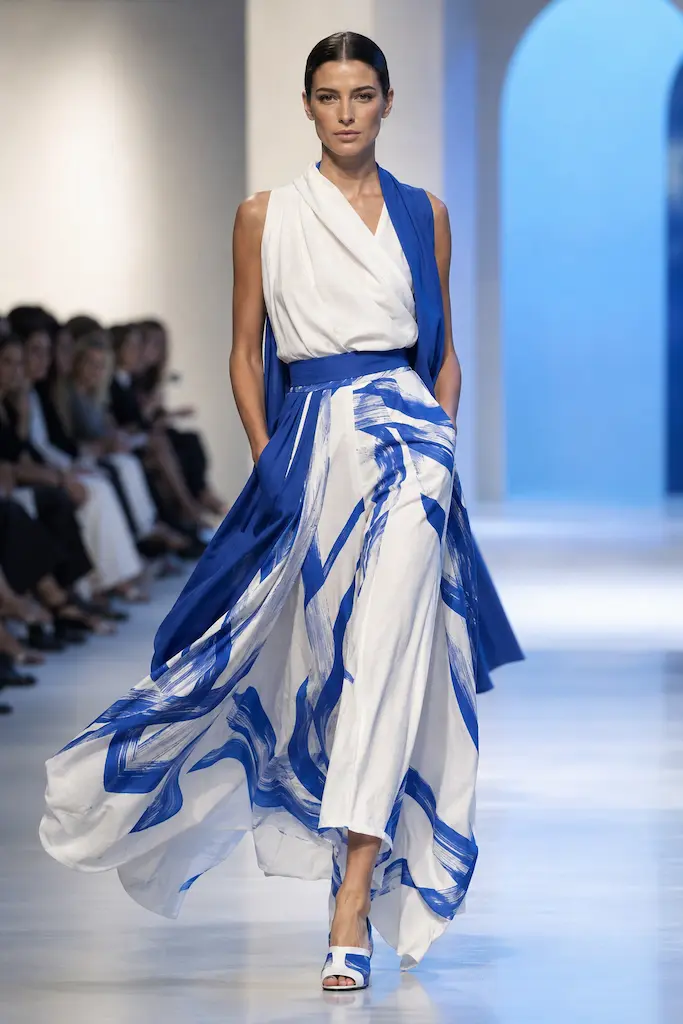
Fashion has always enjoyed ranking things. Some fabrics are permitted to be practical. Others are expected to arrive looking expensive. Cotton spent much of its modern life associated with work, underwear, shirts, denim, uniforms and the useful business of getting dressed. Silk acquired an entirely different reputation: precious, imported, technically demanding and expensive enough to make people behave carefully around dinner. Put them together, however, and the hierarchy begins to look rather silly. A white cotton T-shirt with a fluid silk skirt often feels more modern than silk from shoulder to ankle. A crisp cotton shirt worn over something glossy immediately makes the shine less formal. Even denim—the great democratic cotton fabric—can make silk look less like something waiting for an invitation and more like something a person might actually wear before sunset.
The reason has less to do with rules than contrast. Cotton tends to present a quieter surface. Depending on how it is woven, it can be crisp, soft, heavy, gauzy or densely structured, but we are accustomed to reading it as familiar. Silk behaves differently with light. It can gleam, ripple, fall close to the body or hold considerable structure of its own. Put a matte cotton beside a luminous silk and each becomes more visible because of the other. One does not elevate the other so much as prevent it from becoming predictable. And predictability is where many supposedly luxurious outfits run into trouble. Too much polish can begin to look less expensive rather quickly. Fashion has discovered this repeatedly, though naturally it prefers to call each rediscovery a new styling idea.
The two fibers also arrived at their reputations by very different routes. Cotton became one of the great global everyday textiles because it could be grown, spun, woven and eventually industrialized at enormous scale. Silk began in China and travelled west through long networks of trade, knowledge and production before important silk industries developed around the Mediterranean and elsewhere in Europe. Its scarcity, labor and technical complexity helped give it the cultural status of luxury. Neither fiber was born knowing whether it belonged at breakfast or the opera. People assigned those roles.
That is what makes wearing them together more interesting than simply saying that one is casual and the other elegant. The combination quietly dismantles categories fashion spent centuries constructing.
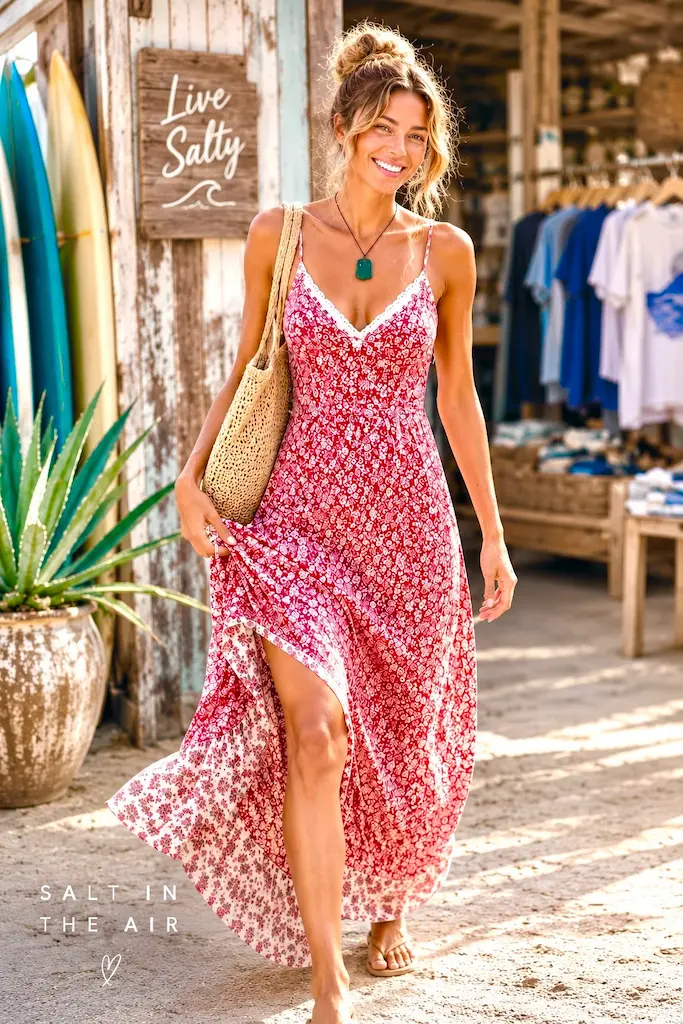
California and the Mediterranean enter this story from opposite directions. California’s relationship with cotton is unusually tangible. Cotton became an important agricultural crop in the state, particularly through the San Joaquin Valley, while cotton fabrics became inseparable from the visual language of California dressing: T-shirts, shirts, canvas, workwear and, most famously, denim. The state did not invent denim, despite what several generations of advertising may have encouraged us to believe, but California helped turn it into a way of dressing that traveled everywhere.
Silk’s Mediterranean history is less about origin than transformation. The fiber came from Asia, but cities and regions around Italy, France, Spain and the wider Mediterranean world became important centers of textile trade, weaving and design. By the time silk entered European fashion at its grandest, it had accumulated an impressive amount of cultural baggage: ceremony, wealth, craftsmanship, status and the unfortunate expectation that someone might spill something on it.
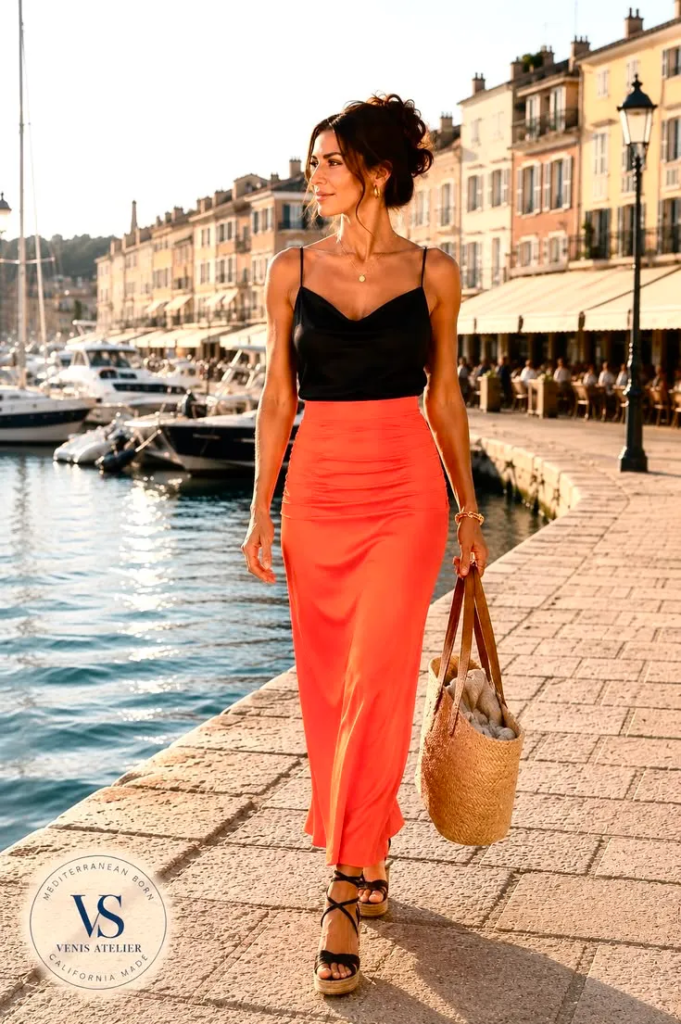
This is where the original idea of California cotton and Mediterranean silk becomes useful—not as a literal claim that each fabric belongs exclusively to one shore, but as shorthand for two traditions of dressing. One values ease, usefulness and clothes that tolerate life. The other has spent centuries refining what fabric can do with movement, color, surface and light. The most interesting Caliterranean wardrobe appears somewhere between them.
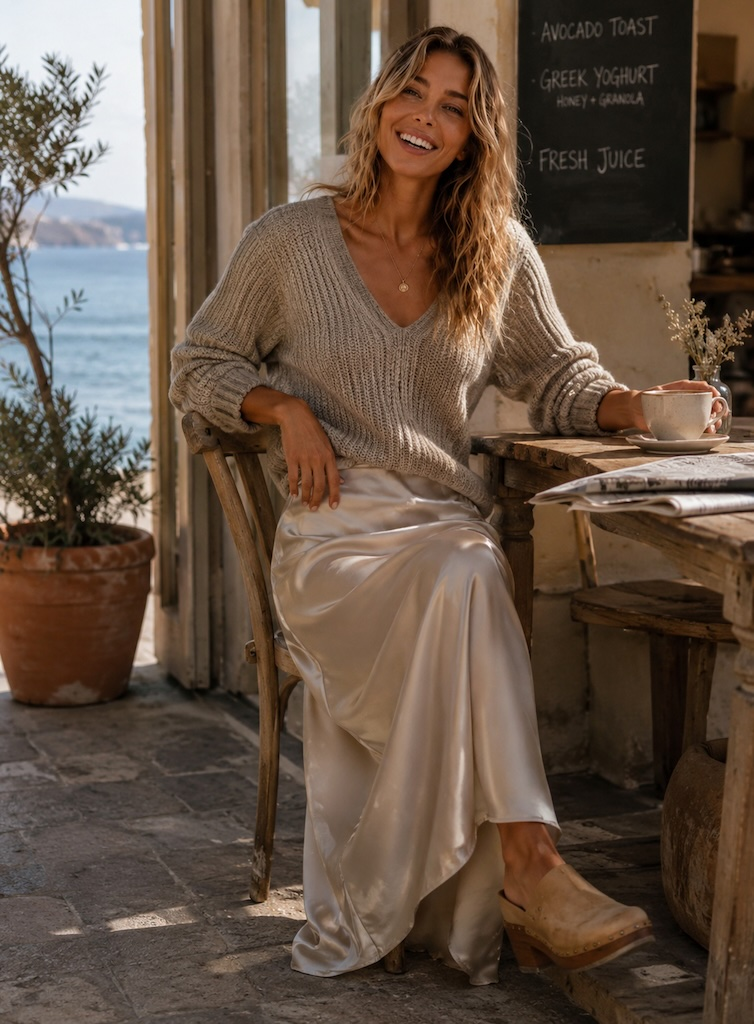
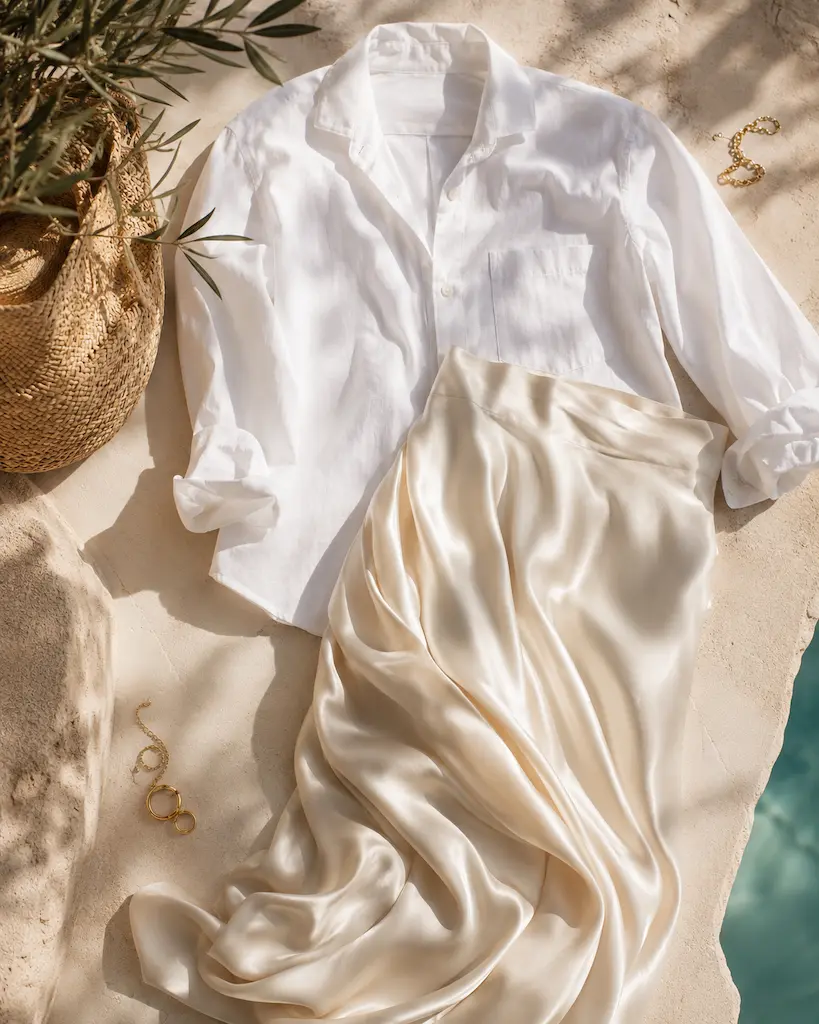
That does not mean dressing half Californian before lunch and half Italian afterward. It means understanding that relaxed clothes become more interesting when one element refuses to be entirely relaxed. A silk skirt beneath a cotton shirt. A lustrous scarf with washed denim. A simple cotton dress with one fluid silk layer. The tension does the styling for you. It also explains why the combination tends to work particularly well by the coast. Coastal dressing has practical demands that fashion photographs occasionally forget. Temperatures change. Wind appears without consulting the outfit. Days move between indoors and outside. Clothing has to tolerate sitting, walking, eating and occasionally being exposed to an alarming amount of sunscreen.
Cotton is good at the practical part. Silk brings movement and surface variation without requiring an elaborate silhouette. Neither needs to impersonate the other.

There is another reason the pairing feels contemporary: luxury itself has changed. For much of fashion history, visible expense was part of the point. Rich cloth, elaborate embroidery, difficult construction and conspicuous quantities of material announced status before anyone had to introduce themselves. Modern wardrobes often work differently. The clothes that look most sophisticated are frequently the ones that interrupt luxury with something ordinary.
A fine skirt and a plain shirt. A beautifully cut jacket and faded jeans. Silk beside cotton. The supposedly lesser fabric gives the precious one somewhere to breathe. This is why the old rule that cotton should form the “base” while silk provides the “finishing touch” is too limiting. Cotton can be beautifully engineered and exquisitely made. Silk can be understated, washed, matte or deliberately informal. Fiber alone does not determine whether a garment is casual or luxurious; weave, construction, weight, finish and cut matter enormously.
Fashion’s fabric stereotypes are useful right up until good clothes contradict them. That contradiction is what makes the combination worth keeping in a Caliterranean wardrobe. Not because California represents comfort while the Mediterranean represents elegance—that would reduce two enormous cultures to a very tidy marketing department—but because both regions offer examples of clothing shaped by climate, material and actual daily life.
The best result is neither “casual” nor “dressy.” It simply feels appropriately unresolved. Cotton takes some of the ceremony out of silk. Silk removes some of cotton’s ordinariness. Together they prove something fashion periodically forgets: contrast is often more compelling than coordination. Perhaps that is why expensive clothes so often look better beside ordinary ones. Luxury can be impressive on its own. It becomes interesting when something refuses to be impressed by it.

How do you build a Caliterranean™ wardrobe? Discover the principles behind dressing with natural fabrics, timeless silhouettes, coastal colours, and the effortless elegance shared by California and the Mediterranean. Continue the journey with Caliterranean™ Style, a beautifully designed 32-page digital journal exploring the philosophy, wardrobe essentials, color palette, fabrics, and timeless pieces that define life on both shores. Explore the Journal →
CONTINUE EXPLORING
Inspired by this story? Continue your journey with The Maxi Linen Dress Worn All Summer